
Indoor Air Quality Systems in Morris County, NJ — Whole-Home Filtration, UV-C, and Fresh-Air Ventilation
The air in your house is making your allergies way worse than outside. Your kid has asthma and you're not sure if your HVAC is making it worse. There's some kind of smell coming from the vents and you can't figure out what it is. Or you keep buying room air purifiers for every bedroom and you're wondering if there's a better way. Protocol Services installs and services indoor air quality systems throughout Morris County, NJ — whole-home air purifiers, UV-C germicidal lights, MERV 13 media filtration, and ERV/HRV fresh-air ventilators. We assess your home first, then recommend the right system for your specific air quality problems. NJ HVAC License #4240. Carrier Factory Authorized Dealer. Call 908-878-6479 for a free IAQ assessment.
NJ HVAC License #4240 • Carrier Factory Authorized Dealer • Rheem Dealer • EPA Section 608 Certified • Serving Morris County Since 2011 Call 908-878-6479 — Free IAQ AssessmentOn qualifying system installations. Soft credit check, approval in minutes, terms 24–84 months. Subject to credit approval. NJ utility rebates may also apply — we handle the paperwork.
Indoor Air Quality Systems for Morris County, NJ Homes — What's Actually in Your Air
According to the EPA, indoor air can be 2–5 times more polluted than outdoor air — even in a quiet Morris County neighborhood. Your HVAC system circulates air throughout the house, which means it can either be your biggest source of indoor pollution or your most powerful tool for cleaning it up. The difference comes down to what's integrated into that system. Protocol Services holds NJ HVAC License #4240 and has been assessing and upgrading home air quality systems in Morris County since 2011.
Morris County has a real IAQ problem baked into its housing stock. A large share of homes here were built between the 1950s and 1980s — construction that pre-dates modern ventilation standards, uses older duct materials, and often has undersized or dirty filter housings that still hold a fiberglass flat filter from 2019. Add in NJ's heavy allergen seasons (tree pollen April–May, grass June–July, ragweed August–October), humid summers that push indoor relative humidity above 65% in basements, and sealed-up winters where VOCs from building materials concentrate in stale air — and you have a legitimate case for upgrading what your HVAC is doing beyond heating and cooling.
Here's the thing: this isn't just about allergies. The EPA revised the annual PM2.5 (fine particulate) national air quality standard to 9 μg/m³ in 2024 because of evidence linking even low-level particulate exposure to cardiovascular and respiratory harm. Morris County is also in EPA Radon Zone 1 — the highest-risk designation — meaning predicted indoor radon levels are above the 4 pCi/L action level. IAQ isn't a premium upsell. For Morris County homes, it's a real health question with practical HVAC answers.
IAQ Systems We Install and Service — From Filtration to Fresh-Air Ventilation
Not every home needs the same fix. Someone asking "what can I put in my HVAC for spring allergies?" has a different problem than someone whose UV lamp hasn't been checked in three years, or a household with a recently tightened energy-efficient home where CO2 and humidity are climbing. Protocol assesses your specific situation and recommends from the following IAQ system categories. For a full overview of all air quality services we offer in Morris County, visit the Air Quality hub.
Whole-Home Media Air Cleaners — MERV 11–16 Filtration
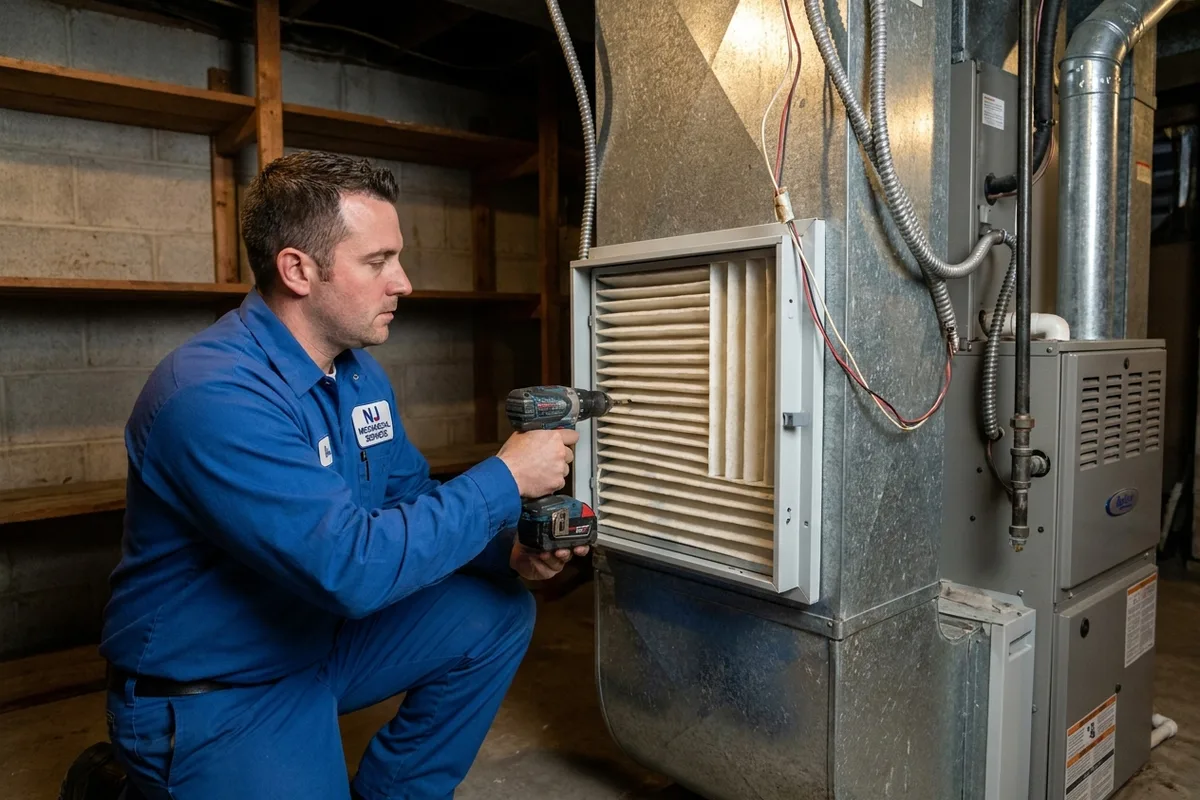
A whole-home media air cleaner installs in your existing HVAC ductwork — at the filter housing or directly on the air handler — and captures particles that standard 1-inch box filters miss. The difference between a MERV 8 standard pleated filter and a MERV 13 media filter isn't just thickness; it's the range of particles captured. MERV 13 catches most bacteria, combustion byproducts, and smoke particles in addition to pollen, dust mites, and pet dander. MERV 8 mostly catches visible dust and large pollen — the stuff that loaded up that gray-pillow filter you pulled out last month.
For most Morris County homes, MERV 13 is the sweet spot — the CDC and ASHRAE recommended this rating during respiratory illness concerns because it captures the particle sizes that carry pathogens. Going higher isn't always better: MERV 14–16 can restrict airflow in older duct systems not designed for high-static filters, which stresses the blower motor and reduces system efficiency. Protocol's IAQ assessment includes a static pressure check to confirm your system can handle an upgrade before we recommend one. We install the Aprilaire 5000 (MERV 16, up to 2,000 sq ft), Honeywell Home F100F2002 (MERV 11), and the Carrier DGAPA Infinity Air Purifier (MERV 15) as a Carrier Factory Authorized Dealer.
Media air cleaners require filter replacement once per year in most homes — compared to buying a 1-inch box filter every 1–3 months. For households where the filter looks like a gray pillow after 90 days, a media cleaner with higher surface area captures more and goes longer between changes.
UV-C Germicidal Lights — Mold, Bacteria, and Virus Inactivation
UV-C germicidal lights installed inside your HVAC system use 254-nanometer ultraviolet light to inactivate bacteria, mold spores, and viruses as they pass through the air stream or accumulate on the evaporator coil. The science is CDC-grounded: UV-C at 200–280 nm disrupts DNA/RNA replication in microorganisms, rendering them unable to reproduce. It's the same principle used in hospital air handling systems, applied at residential scale.
There are two common configurations. Coil-mount UV lamps keep the evaporator coil from growing mold between cooling cycles — Morris County's humid summers create exactly the dark, damp environment where coil mold thrives. In-duct air-stream lamps target pathogens in the moving airflow. Many installations use both. A standard single-lamp UV install runs $400–$900 installed; dual-lamp systems (coil + air stream) run $800–$1,500. UV bulbs need annual replacement — even if they're still glowing, output degrades significantly by month 9–12 and the germicidal effect is gone.
The Carrier Infinity Air Purifier (DGAPA) combines MERV 15 media filtration with Captures and Kills technology — inactivating pathogens captured on the filter media rather than just trapping them. As a Carrier Factory Authorized Dealer, Protocol installs and services this system integrated with Carrier Infinity equipment or as a standalone in-duct upgrade.
Energy Recovery Ventilators (ERV) and Heat Recovery Ventilators (HRV)
This is the IAQ upgrade that most homeowners haven't heard of — but it solves the problem that filters and UV lights can't: stale air. The EPA recommends combining filtration with source control and ventilation for effective IAQ. ASHRAE Standard 62.2-2022 sets the minimum mechanical ventilation rate for residential buildings based on floor area and bedroom count. Most Morris County homes built before 2000 were ventilated by air leakage — drafts, gaps, and imperfect envelopes. Newer tight construction and weatherization upgrades eliminate those leaks, which is great for energy bills but terrible for CO2 buildup, VOC off-gassing from furniture and finishes, and moisture control.
An ERV (Energy Recovery Ventilator) or HRV (Heat Recovery Ventilator) brings in fresh outdoor air and exhausts stale indoor air simultaneously — but with a heat exchanger core that recovers 70–80% of the heating or cooling energy from the outgoing air. You get ASHRAE 62.2-compliant fresh air without paying to condition an entirely new batch of outdoor air from scratch. Note that HRV installations pair naturally with whole-home humidity control — if your Morris County home runs dry below 30% RH in winter, addressing both ventilation and humidification together gives you the most complete solution.
The HRV vs. ERV choice matters in NJ. An HRV transfers heat only — better for Morris County's cold winters where you want to exhaust indoor humidity rather than preserve it. An ERV transfers both heat and moisture — better for milder spring and fall conditions where indoor humidity is already low and you don't want to dry the air further. Protocol recommends based on your home's actual humidity profile, not a one-size recommendation. The Aprilaire 8126 HRV (130 CFM, homes up to 3,000 sq ft) and Aprilaire 8600 ERV (150 CFM, with integrated humidity sensor) are our primary installation platforms, ranging $1,500–$3,500 installed depending on ductwork modifications needed.
IAQ vs. HVAC — Why They're Different and Why That Matters
Your HVAC system's job is thermal comfort — heating and cooling air to hit your thermostat setpoint. An IAQ system's job is what's in the air, not just its temperature. A properly sized Carrier or Rheem AC system can cool your Morris County home to exactly 72°F while that same 72°F air carries PM2.5 particulates, VOC off-gassing from the new flooring you just installed, mold spores from a damp duct section, and CO2 levels high enough to cause afternoon fatigue. IAQ upgrades operate in parallel with your HVAC system — they use the same air distribution but address a completely different problem set. That's why they're evaluated separately and sized against the actual pollutant load in your home, not just your system's BTU capacity.
Why Morris County Homeowners Choose Protocol for Indoor Air Quality
The first question a lot of homeowners ask is the right one: "Is this worth the money, or is my HVAC contractor just trying to sell me something?" It's a fair question — the IAQ product market has plenty of noise, and some contractors recommend the most expensive option regardless of actual need. Protocol's approach is the opposite: we assess first. If your MERV 8 filter is doing the job and your ventilation is adequate, we'll tell you that instead of selling you a $3,000 ERV you don't need.
Here's what separates Protocol's IAQ work from a generic "upgrade package" pitch:
- Assessment before recommendation. We measure static pressure, check your existing filter housing size and MERV compatibility, assess duct condition, and evaluate your home's ventilation rate against ASHRAE 62.2-2022 before recommending any system. Higher MERV is not always better — a MERV 16 filter in a duct system designed for MERV 8 can restrict airflow enough to damage your blower motor. Our assessment also covers your water quality — Morris County well water with high hardness accelerates scale buildup in humidifier water panels and ERV cores, which directly affects how long IAQ equipment lasts between service intervals.
- NJ HVAC License #4240. UV-C lamp installation and ERV/HRV integration involve electrical connections to the air handler. This isn't DIY territory — NJ requires a licensed HVAC contractor for any work affecting the air distribution system. Protocol is fully licensed, bonded, and insured in New Jersey.
- Carrier Factory Authorized Dealer. We install the Carrier Infinity Air Purifier, Carrier UV lamps, and the full Aprilaire IAQ lineup. Factory authorization means factory-backed warranties — your Carrier Infinity system warranty isn't voided by an aftermarket add-on. IAQ upgrades also perform best when the underlying HVAC system is running cleanly; annual AC maintenance keeps the evaporator coil and blower free of the buildup that undermines air quality equipment installed downstream.
- Annual maintenance included. UV bulbs lose germicidal effectiveness by month 9–12. Media filter pads need annual replacement. ERV/HRV cores need cleaning. Protocol includes these IAQ maintenance touchpoints in our annual HVAC service visits so you're not running a UV light with a spent bulb and wondering why it's not working.
- Morris County-specific knowledge. We know this housing stock — the oversized ducts in 1970s colonials, the damp basements in lake-community homes in Denville and Kinnelon, the pollen load in Randolph and Parsippany from April through October. IAQ recommendations for a Morris County home look different from a statewide generic playbook.
IAQ systems are part of Protocol's full air quality services in Morris County — which also covers humidity control and water filtration solutions.
Finance Your Indoor Air Quality System
A whole-home IAQ system — whether that’s a MERV 15 media air cleaner, UV-C germicidal lights, or an ERV/HRV ventilator — is an investment in your family’s health that pays back every allergy season. Protocol Services offers financing options for qualified customers — including 0% APR promotional terms — so you can move forward today without waiting. Ask about current financing options when you schedule your free IAQ assessment.
Explore Financing Options Call (908) 878-6479Trusted by Morris County Homeowners
Real reviews from Rockaway, Dover, Wharton, and surrounding communities.
How Our IAQ Assessment and Installation Process Works
- Free IAQ consultation. We discuss your symptoms — allergy flare-ups, odd smells from vents, fatigue in the house, visible mold near returns — and identify your primary concerns. This shapes the assessment focus.
- HVAC system review. We inspect your filter housing, current filter type and MERV rating, duct condition, and air handler. Static pressure is measured to confirm filter upgrade compatibility. We check your ERV/HRV situation — or lack thereof — against your home's floor area and occupancy for ASHRAE 62.2 compliance.
- Pollutant profile discussion. Pets, recent renovation (VOC off-gassing), older home materials, basement moisture, radon zone awareness — these all affect which IAQ systems address your actual problem versus which are overkill.
- Written recommendation with options. You get a tiered recommendation: Phase 1 (highest-impact, lowest-cost fix), Phase 2 (full system if budget allows), and what to skip. No pressure to buy the full package same day.
- Installation. Most whole-home media cleaner and UV-C installations are completed in 2–4 hours with no major ductwork modification. ERV/HRV installations typically take a full day and may require duct modifications — we scope this in advance.
- Verification and walk-through. After installation, we verify airflow hasn't been compromised, test the UV lamp output, and confirm ERV/HRV airflow rate. You get a written maintenance schedule — when to replace the filter media, when to swap the UV bulb, when to clean the ERV core.
Indoor Air Quality Systems — Frequently Asked Questions
- Is the air inside my home really more polluted than outside?
- Yes — EPA research consistently shows indoor air can be 2–5 times more polluted than outdoor air. Morris County's older housing stock traps dust, VOCs from building materials, mold spores from damp basements, and pet dander in tightly run forced-air systems. Without adequate ventilation and filtration, those pollutants recirculate through every room every time the HVAC runs. The issue isn't unique to old homes — newer tight construction post-2000 has even less natural air exchange, which drives up CO2 and VOC concentrations.
- How much does a whole-house air purifier cost in New Jersey?
- Installed cost ranges from $600–$1,200 for a whole-home media air cleaner (Aprilaire 2410 or Honeywell F100 equivalent), $400–$900 for a single in-duct UV-C germicidal lamp, and $1,500–$3,500 for an ERV or HRV system depending on ductwork modifications needed. The Carrier Infinity Air Purifier with MERV 15 and Captures and Kills technology runs $800–$1,500 installed as a Carrier authorized dealer installation. Price ranges sourced from HomeAdvisor 2024 national averages and Aprilaire dealer price lists. Protocol provides written estimates before any work starts — call (908) 878-6479.
- What's the difference between MERV filters and HEPA filters?
- MERV (Minimum Efficiency Reporting Value, per ASHRAE Standard 52.2) is the rating scale used for HVAC filters — runs 1–20, with MERV 13 being CDC- and ASHRAE-recommended for residential use during respiratory illness concerns. HEPA is a performance standard (99.97% capture of 0.3-micron particles) typically used in portable standalone purifiers or dedicated bypass filtration systems — not directly in your HVAC return because the high static pressure would over-restrict most residential blower motors. For Morris County forced-air systems, MERV 13 delivers excellent particle capture (pollen, dust mites, pet dander, most bacteria) without the airflow penalty of true HEPA. Not all high MERV ratings are equal: go above MERV 13 without a system assessment and you risk blower motor damage from restricted airflow.
- Does UV light in an HVAC system actually kill germs?
- Yes — UV-C light at 254 nm disrupts the DNA and RNA of bacteria, viruses, and mold spores, inactivating them and preventing reproduction. This is CDC-documented technology used in hospital infection control. In residential HVAC, UV-C lamps are installed at the evaporator coil (to prevent mold growth on the damp coil surface) or in the air stream (to inactivate pathogens passing through). The important caveat: UV bulbs need annual replacement. The lamp may still glow after 12 months but UV-C output drops significantly — a spent bulb does nothing germicidal. Protocol includes UV bulb inspection in annual HVAC maintenance visits.
- What's the difference between an ERV and an HRV ventilation system?
- Both bring fresh outdoor air in and exhaust stale indoor air out, recovering 70–80% of heating or cooling energy in the process — this is how you get ASHRAE 62.2-compliant ventilation without blowing your utility bill. The difference: an HRV (Heat Recovery Ventilator) transfers heat only. An ERV (Energy Recovery Ventilator) transfers both heat and moisture. For Morris County's cold, dry winters — when indoor RH can drop below 20% with the furnace running — an HRV is typically preferred because it exhausts excess indoor humidity rather than preserving it. For shoulder seasons or homes where humidity control isn't the driver, ERV is appropriate. Protocol recommends based on your home's actual measured humidity profile, not a one-size answer. The Aprilaire 8126 HRV and 8600 ERV are our standard installation platforms.
- Can poor indoor air quality cause health problems?
- Yes. Respiratory irritation, worsened asthma symptoms, allergy flare-ups, fatigue, and headaches are all linked to poor IAQ — consistent findings documented by the EPA, the American Lung Association, and ASHRAE. Fine particulate matter (PM2.5) penetrates deep into lung tissue; VOCs from common household products affect the nervous system at sustained exposures; mold spores trigger asthma and allergic reactions. Children, elderly residents, and anyone with existing respiratory conditions are most affected. If your allergies are worse inside than outside, or you consistently feel better after leaving the house, your IAQ is worth a professional assessment before attributing symptoms to seasonal causes.
- Should I get a portable air purifier or a whole-home system?
- A portable air purifier treats one room — typically 200–400 sq ft — and only while running in that room. If you're buying portables for the bedroom, living room, and kids' rooms separately, you're spending $300–$800 per year on units that leave the rest of the house untreated. A whole-home media air cleaner integrates with your existing HVAC and cleans every cubic foot of air that circulates through the system — typically 5–7 full air changes per day in a standard Morris County forced-air home. For households that have already accumulated 2–3 portable units across rooms, the whole-home system usually pays for itself in 2–3 years compared to portable replacement and filter costs. The EPA's Guide to Air Cleaners in the Home confirms that whole-home HVAC-integrated systems deliver broader coverage than portable room units.
- Can I add an air purifier to my existing HVAC system?
- Yes — most forced-air systems in Morris County can be retrofitted with a whole-home media air cleaner, UV-C lamp, or electronic air cleaner without major ductwork modification. The installation point is typically the filter housing or plenum just before the air handler. The key step first is a static pressure measurement: adding a high-MERV media filter to a system designed for 1-inch disposables can over-restrict airflow and damage the blower. Protocol checks compatibility before recommending any upgrade. For ERV/HRV, ductwork modifications are usually needed — this is scoped in the initial assessment.
- How often should I change my HVAC air filter?
- Standard 1-inch pleated filters: every 1–3 months, but check monthly during Morris County's pollen peaks (April–May for tree pollen, June–July for grass, August–October for ragweed). If the filter looks like a gray pillow after 60–90 days, you're in a high-particulate environment — upgrade to a whole-home media cleaner with a 4–5-inch media pad that has more surface area and lasts 12 months. Pet owners and homes near high-traffic roads (Rt. 46 corridor, I-287) typically see faster filter loading. MERV 11–13 during pollen season is the sweet spot — captures allergens without over-restricting airflow for most Morris County HVAC systems.
- Is mold in my air ducts dangerous?
- Yes. Mold spores that grow on or near the evaporator coil or in ductwork recirculate through every room via your HVAC system, triggering respiratory symptoms, worsening asthma, and causing allergic reactions. NJ DEP documents mold as a significant indoor air quality hazard. Morris County's humid summers (basement RH regularly exceeds 65%) create ideal mold growth conditions at the coil and in duct sections with poor airflow. UV-C coil lamps are the primary preventive solution — installed at the coil, they continuously suppress mold growth on the damp coil surface. If you see black material near vents or smell a musty odor when the system runs, call for an IAQ assessment before the issue spreads.
- Are there rebates or incentives for indoor air quality systems in New Jersey?
- The NJ Clean Energy Program and utility programs through PSE&G and JCP&L periodically offer rebates for whole-home ventilation upgrades — ERV and HRV systems can qualify under certain whole-home energy efficiency program tiers. Energy Star-rated equipment may qualify for federal tax credits under the Inflation Reduction Act's Home Energy Efficiency Credit (Form 5695). Protocol provides documentation for rebate applications for qualifying systems. Specific rebate availability changes seasonally — call (908) 878-6479 for current NJ incentive status on the system you're considering.
- Do older homes in Morris County have worse air quality?
- Generally, yes. Pre-1980 Morris County homes — the colonials, cape cods, and split-levels that make up a large share of housing in Randolph, Denville, and Rockaway — were built before modern ventilation standards and often have oversized ductwork, unsealed return chases, and older insulation that sheds fibers over time. Older duct materials and fiberglass duct board can harbor mold at joints. The ventilation design in pre-1980 homes relied on air leakage through the building envelope — as those homes get weatherized for energy efficiency, the natural air exchange that diluted CO2 and VOCs disappears. An IAQ assessment is the right first step before any filtration or ventilation upgrade, so the system is sized to your home's actual pollutant load.
- Is radon a concern in Morris County NJ homes?
- Yes — Morris County is in EPA Radon Zone 1, the highest-risk designation, meaning predicted indoor radon levels are above the EPA's 4 pCi/L action level. Radon is the second-leading cause of lung cancer in the US (approximately 21,000 deaths per year per EPA estimates), and it enters homes through foundation cracks and sump pits in the granite-rich soil geology common in Morris County's western townships. NJ P.L. 2012, c.15 requires radon testing disclosure at residential sale. Protocol's IAQ assessment includes radon awareness and can refer you to NJ-certified radon mitigation contractors if testing shows elevated levels. Radon mitigation is a separate service from HVAC-based IAQ — we're transparent about what's in our scope and what requires a different specialist.
- What does an indoor air quality assessment include?
- Protocol's IAQ assessment covers: existing filter type, MERV rating, and housing size; static pressure measurement to confirm filter upgrade compatibility; visual inspection of the air handler, coil, and accessible duct sections for mold or contamination; review of your HVAC system age and refrigerant type; discussion of symptom triggers (allergies, odors, humidity complaints, headaches); and a comparison of your home's ventilation rate against ASHRAE 62.2-2022 requirements. We identify which IAQ problem categories apply to your home and provide a tiered written recommendation. The assessment is free — call (908) 878-6479.
- What HVAC air filter should I use to reduce allergies?
- MERV 11–13 is the recommended range for allergy sufferers — it captures pollen (tree, grass, ragweed), dust mite allergens, pet dander, and mold spores without restricting airflow to the point where it stresses your blower motor. During Morris County's pollen season (April–October), replace your filter every 30–60 days — the heavy pollen load loads filters faster than the package suggests. If you're replacing filters monthly because they're clogged, that's the right trigger to upgrade to a whole-home media air cleaner: the Aprilaire 5000 (MERV 16) has enough surface area to run a full year between changes even in high-pollen environments. Remember that higher MERV is not universally better — get a static pressure check before jumping to MERV 14+.
Indoor Air Quality Systems — Morris County, NJ
Protocol Services is your local source for whole-home air purifiers, UV-C germicidal lighting, MERV 13 media filtration, and ERV/HRV fresh-air ventilation throughout Morris County, NJ. Licensed, bonded, and insured — serving the area since 2011.
Protocol Services - Electric & Air
350 US-46 Suite 217Rockaway, NJ 07866 (908) 878-6479
Indoor Air Quality Systems
Licensed · Bonded · Insured
NJ HVAC License #4240
EPA Section 608 Certified · Carrier Factory Authorized Dealer
Aprilaire Dealer · Rheem Dealer
Serving Morris County Since 2011
About Morris County, NJ
Morris County is one of New Jersey's most prosperous counties, home to approximately 509,000 residents spread across 39 municipalities ranging from the densely developed downtown of Morristown to the lake communities of Rockaway Township, Denville, and Kinnelon. The county's terrain — rolling highlands, river valleys, and dozens of named lakes — creates a mix of older housing stock (many homes built in the 1950s–1970s) and newer suburban developments, all of which generate strong demand for electrical upgrades, HVAC system replacements, and air quality services. Protocol Services - Electric & Air is headquartered in Rockaway at 350 US-46 and serves communities throughout Morris County, from the Route 46 corridor near Dover and Mine Hill to the affluent townships of Randolph and Parsippany-Troy Hills.
Morris County Communities We Serve for Indoor Air Quality Systems
Outside this list? Call (908) 878-6479 — we serve all of Northern NJ and can accommodate surrounding counties.
Other HVAC & Air Quality Services From Protocol
Schedule Your Free Indoor Air Quality Assessment
You don't have to guess what's in your air. Protocol Services holds NJ HVAC License #4240, has been serving Morris County since 2011, and installs Carrier, Aprilaire, and Honeywell Home IAQ systems — whole-home air purifiers, UV-C germicidal lights, MERV 13 media filtration, and ERV/HRV fresh-air ventilation. The assessment is free. The recommendation is honest — if you don't need a $3,000 ERV, we'll tell you that.
External IAQ resources: EPA Guide to Air Cleaners in the Home | Energy Star Air Purifier Ratings | ASHRAE 62.2 Ventilation Standard
Call (908) 878-6479 — Free IAQ Assessment