How do I choose a good heating company in Morris County NJ?
Look for three things: a current NJ HVACR contractor license (verifiable at njconsumeraffairs.gov), liability insurance, and a documented in-home assessment process — never accept a heating quote over the phone. Ask for the license number directly. Protocol's NJ HVAC license is #4240. A company that hesitates to give you their license number is a company you don't need to hire.
Are HVAC contractors licensed in New Jersey for heating work?
Yes — NJ requires a separate HVACR contractor license for all heating work. A general contractor's license does not cover gas, oil, or heat pump systems. To verify any heating contractor's license, search at njconsumeraffairs.gov/hvacr. Protocol holds NJ HVAC License #4240, covering all heating installation, repair, and fuel-conversion work across Morris County.
What NJ rebates are available for heating system upgrades?
The NJ Clean Energy Program offers up to $7,500 for qualifying heat pump installations. PSE&G and JCP&L layer additional utility rebates of $1,300–$1,400, bringing stacked rebate potential to approximately $8,900. NJNG SAVEGREEN rebates up to $600 apply to high-efficiency gas furnace replacements. Federal IRA Section 25C adds a 30% tax credit — up to $2,000 for heat pumps and $600 for ENERGY STAR furnaces. These programs require a licensed NJ HVAC contractor. Current amounts: verify at njcleanenergy.com before your project.
How much does furnace replacement cost in New Jersey in 2026?
Furnace replacement in NJ runs roughly $4,500–$9,500 installed, depending on AFUE rating, brand, and whether ductwork modifications are needed. An 80% AFUE standard furnace typically runs $4,500–$6,000 installed. A 95–96% AFUE high-efficiency unit — the tier that qualifies for NJ rebates and the federal 25C credit — typically runs $6,000–$9,500. The higher upfront cost of a high-efficiency unit often pays back in 5–7 years through gas savings, and NJNG SAVEGREEN rebates reduce the gap further.
Is it cheaper to repair or replace my furnace?
Use the 50% rule: if the repair cost exceeds 50% of what a new system would cost, and your furnace is 15 or more years old, replacement almost always makes more financial sense. A 22-year-old furnace that needs an $1,800 repair is almost certainly a replacement situation — that repair bill is money you'll never recover in a system with limited remaining life. Also consider efficiency: replacing a 70% AFUE furnace with a 95% unit can cut your annual heating bill 20–25%.
Can I finance a new furnace or heating system?
Yes. Protocol offers financing with 0% promotional-period options, so you can spread the cost of a $5,000–$9,000 system over manageable monthly payments instead of writing one check. Apply during the quote visit — approval is typically fast. Financing a replacement makes especially strong sense when your current system is over 15 years old, has had multiple repairs, and is costing you more in utility bills every year.
Do heat pumps work in New Jersey winters?
Modern cold-climate heat pumps do — and the "they don't work in NJ" concern usually comes from experience with older equipment. The Carrier Infinity 20 heat pump operates at full rated capacity down to 5°F and maintains heating output down to -13°F. Morris County's average January low is around 22°F, so for most of the heating season a cold-climate heat pump doesn't need backup heat at all. For sub-5°F events, a dual-fuel system adds a gas furnace that activates automatically. You get heat pump efficiency most of the winter and gas furnace reliability when you need it.
What is AFUE and why does it matter for my furnace?
AFUE (Annual Fuel Utilization Efficiency) measures what percentage of the fuel you buy actually becomes heat in your home. An 80% AFUE furnace turns 80 cents of every gas dollar into heat and wastes 20 cents up the flue. A 95% AFUE furnace wastes only 5 cents. On a Morris County heating season with around 200 heating days per year, the difference between 80% and 95% AFUE can be $300–$400 in annual gas savings — and the more efficient unit qualifies for rebates the 80% unit doesn't.
What's the difference between a furnace and a boiler?
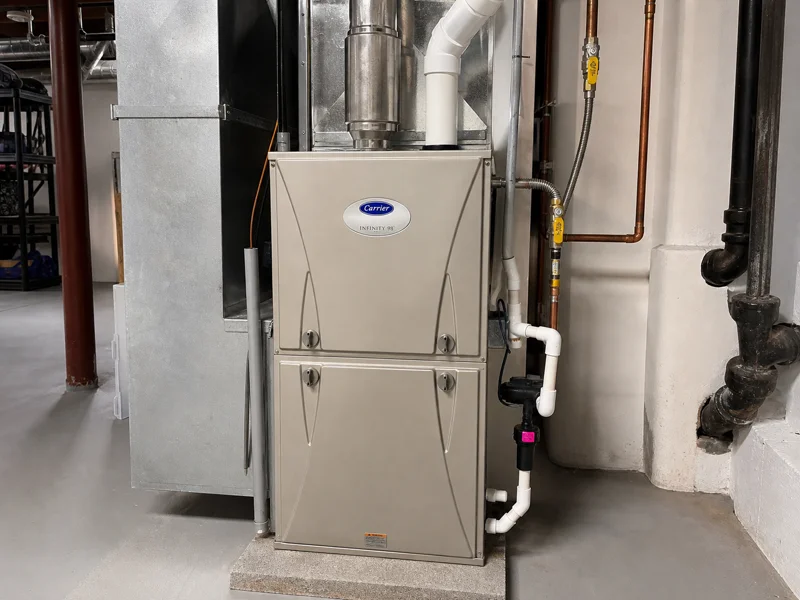
A furnace heats air and distributes it through ductwork — the most common system in homes built after 1985. A boiler heats water and distributes heat through radiators, baseboard convectors, or in-floor radiant tubing. Many older Morris County colonials and Victorians still have boiler systems — they provide even, comfortable heat but work differently than forced-air systems. Protocol services and replaces both. If you have cast-iron radiators or baseboard fin-tube convectors, you have a boiler, and we handle it.
Should I convert from oil heat to gas or install a heat pump?
Both are strong upgrades from oil. A gas conversion is lower upfront ($5,800–$18,600 depending on gas access and tank situation) and straightforward if natural gas runs to your street. A heat pump costs more upfront but qualifies for significantly larger NJ rebates — up to $8,900 stacked — and eliminates both the efficiency penalty of oil and the environmental liability of an aging oil tank. Dual-fuel systems (heat pump + gas backup) give you the best of both if you want electrification without giving up cold-weather reliability. We'll walk you through both options at the in-home quote — no pressure to go one direction.
My oil tank is old and I'm scared it's going to leak into my yard. What do I do?
That fear is well-founded. Underground and above-ground oil tanks that have outlived their service life can leak, and NJ DEP environmental remediation costs can reach $50,000 or more for a contaminated soil situation. Oil-to-gas conversion eliminates the ongoing liability. Protocol handles oil tank decommissioning per NFPA 31 as part of the conversion process — properly capping or removing the tank and coordinating with NJ DEP requirements. Call us before the leak happens, not after.
What should I do if my heat goes out in winter?
Check these first: thermostat settings and battery, circuit breaker position, air filter (a clogged filter can trigger a safety shutdown), and pilot light or igniter. If you don't have heat within 10 minutes of checking those, call (908) 878-6479 — Protocol dispatches 24/7 for heating emergencies in Morris County. Don't wait until pipes freeze. A single frozen pipe burst in a Morris County home can cost more to fix than a full furnace replacement.
I smell gas near my furnace — should I call you or should I call PSE&G?
Call 911 and PSE&G first — not us. If you smell a sulfur or rotten-egg odor near your furnace, that's the mercaptan odorant added to natural gas so you can detect a leak. Immediately: stop using any electrical switches or devices inside the house, leave the house, and call 911 and PSE&G (1-800-880-7734) from outside. Do not re-enter until the gas company clears the scene. Once the utility confirms it's safe to return, that's when you call Protocol to inspect and repair the furnace. Gas leaks are a life-safety situation — the HVAC tech comes second.
Why does my furnace keep turning on and off?
That's called short-cycling, and the most common causes are: a clogged air filter restricting airflow (replace the filter first — it's a 2-minute fix), a faulty limit switch overheating the heat exchanger, or an oversized furnace that heats the space too quickly. Short-cycling wears out components faster and means your home heats unevenly. If replacing the filter doesn't fix it within a heating cycle or two, call for a diagnostic.
What does a banging noise from my furnace mean?
A bang or boom at startup usually means delayed ignition — gas accumulates before the burner lights, then ignites in a small controlled explosion. It's startling, and it's also a problem: repeated delayed ignition stresses the heat exchanger, which can crack over time. A cracked heat exchanger allows combustion gases — including carbon monoxide — to mix with the air your family breathes. Don't put off getting that looked at.
When should I schedule annual furnace maintenance?
September or October is ideal — before the first cold snap hits and before HVAC contractors are slammed with emergency calls. Most Carrier and Rheem equipment warranties require documented annual service to remain valid. Skipping maintenance doesn't just void warranties; it also means nobody's checking your heat exchanger for cracks, your igniter for wear, or your gas valve for proper operation. The $100–$150 tune-up cost is cheap insurance against a $1,500 mid-winter repair call.
How long does a furnace last?
Well-maintained gas furnaces typically last 15–20 years. Morris County's cold winters mean longer annual runtime than climates with milder winters, which can put systems at the lower end of that range. Indicators it's time to replace: age 15 or older, repair costs exceeding 50% of replacement value, noticeably increasing energy bills despite usage staying constant, or uneven heating that wasn't a problem before. If your furnace was installed before 2010, it's worth having it assessed.
How many quotes should I get for a new heating system?
Three to five quotes from licensed NJ HVAC contractors is the standard recommendation. But compare what the scope includes — a low quote that excludes permit fees, equipment disposal, gas line work, or proper ductwork modifications isn't a real comparison. Any quote given without an in-home visit and Manual J load calculation is an estimate at best. At Protocol, we don't quote without coming to the house — full stop.
What questions should I ask a heating contractor before hiring?
Ask: Are you licensed in NJ for HVAC work — and what's your license number? Do you carry liability insurance? Will you do a Manual J load calculation before quoting? Do you pull mechanical permits? What's your labor warranty? What brands do you install? Can you provide three recent references from jobs in Morris County? A licensed, established contractor answers all of these without hesitation.
How can I lower my heating bill in NJ?
The highest-impact moves: upgrade to a 95%+ AFUE gas furnace or a heat pump (both reduce fuel waste significantly), install a smart thermostat with setback programming, and have duct leaks sealed — studies show up to 30% of heating efficiency can be lost through leaky ductwork. NJ Clean Energy Program offers rebates for most of these upgrades. Behavioral changes (setback at night, closing off unused rooms) add another 10–15%. Start with the equipment — the efficiency gains there compound over 15–20 years.