Water Softener & Water Filtration in Morris County, NJ — Whole-House and Point-of-Use Solutions
Your water tastes off. The fixtures have orange stains. The dishwasher leaves spots on everything. You’re on a private well and you’re not sure what’s actually in it. Or you just moved to Morris County and someone mentioned PFAS and now you’re looking into water filters for the first time. Protocol Services offers water filtration and water softening throughout Morris County, NJ — whole-house point-of-entry systems, point-of-use reverse osmosis, UV disinfection, and water testing so you know what you’re treating before you treat it. Licensed and insured in New Jersey, serving the area since 2011. Call 908-878-6479 to schedule a free water consultation.
Licensed & Insured in NJ • Carrier / Rheem Dealer • Serving Morris County Since 2011 • Whole-House + Point-of-Use Water Filtration • Water Testing First Call 908-878-6479 — Free Water ConsultationWater Filtration in Morris County, NJ — What Your Water Actually Contains
Morris County groundwater and municipal supplies carry a range of contaminants that vary by town, water source, and housing age. Hard water — calcium and magnesium dissolved from the region’s limestone and granite bedrock — is the most widespread issue: Morris County water hardness typically ranges from 7 to 20+ grains per gallon (GPG) depending on your municipality and whether you’re on a public supply or a private well. At 7 GPG you’ll see scale on fixtures; at 12+ GPG, water heaters, dishwashers, and washing machines accumulate mineral buildup that shortens their lifespan. We’ve been addressing those problems in Morris County homes since 2011 — hard water treatment is one of the most common calls we get.
Beyond hardness, Morris County’s mix of older municipal infrastructure and private well communities creates a genuinely varied set of water quality concerns. Dover’s housing stock — many homes built in the 1950s with older service lines — raises real concerns about lead at the tap, and the EPA tightened the action level under the Lead and Copper Rule Improvements (LCRI) finalized in 2024. Well water in the mining heritage areas around Mine Hill, Wharton, and Mount Hope can carry elevated iron (above 0.3 mg/L) and manganese (above 0.05 mg/L) — both well above EPA secondary maximum contaminants — producing the brown staining on sinks and laundry that’s a familiar complaint in those communities. Tannins from the organic material in lake-adjacent soils show up in Denville’s Indian Lake and Cedar Lake areas, turning water a yellow-brown tint that no amount of sediment filtration alone will fix.
Then there’s PFAS. New Jersey was the first state to set a Maximum Contaminant Level (MCL) for PFOA and PFOS in drinking water, at 14 parts per trillion (ppt) — significantly stricter than the EPA’s current federal MCLs. NJ DEP drinking water monitoring data has flagged PFAS detections in several Morris County public water systems. If your water comes from a public supply, NJ requires your utility to test and report. If you’re on a private well in Morris County, under NJ’s Private Well Testing Act (P.L. 2002, c.11), you’re required to test at the point of sale — but ongoing monitoring between transactions is your responsibility. Granular activated carbon (GAC) filtration certified to NSF/ANSI Standard 53 is the current EPA-recommended technology for PFOA/PFOS reduction at the point of entry or point of use.
Water Filtration Systems We Install and Service — From Whole-House to Point-of-Use
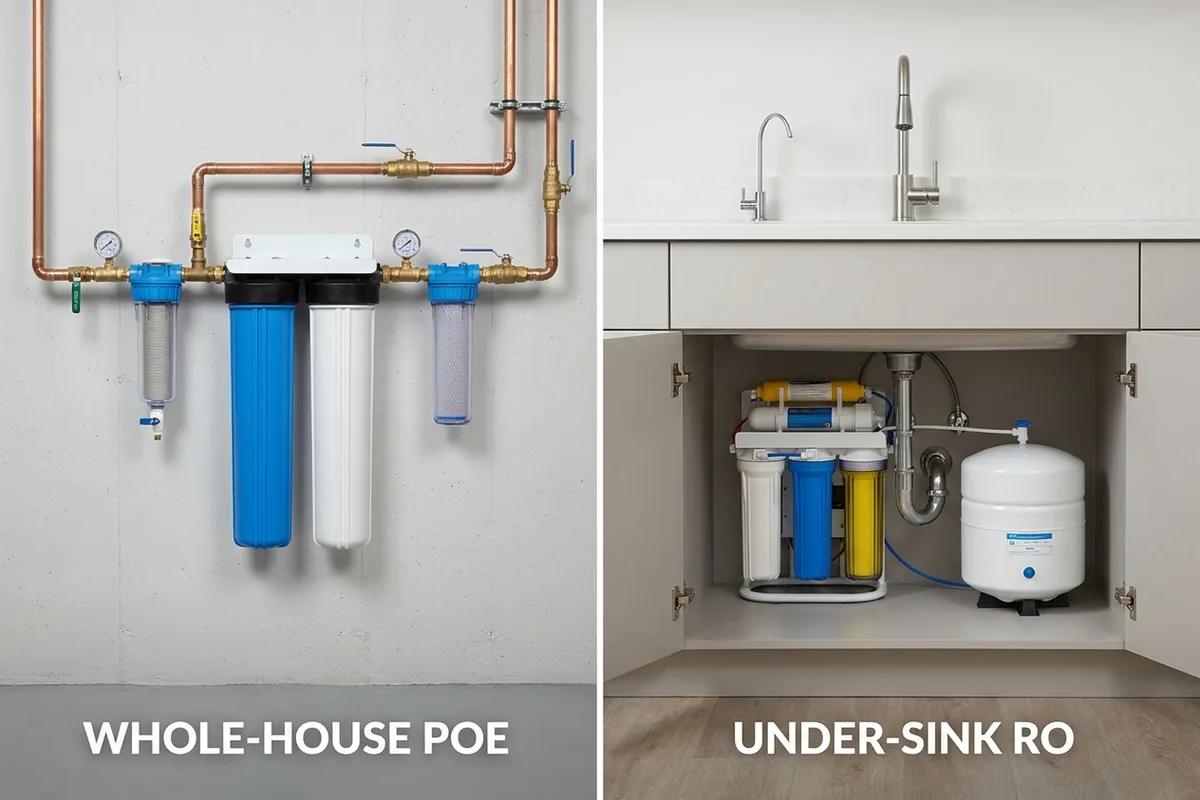
The right system depends on what’s actually in your water — which is why we test before we recommend. A water softener addresses hardness but does nothing for PFAS or bacteria. A UV system handles microbial contamination but won’t touch dissolved minerals or VOCs. Most well-water households in Morris County need a multi-stage approach, and even municipal water users often benefit from point-of-use filtration at the kitchen tap for drinking and cooking. Here’s what we install and what each system addresses:
Water Softeners — Ion Exchange for Hard Water
A whole-house water softener is the standard solution when hardness is your primary problem. Ion exchange resin in the tank swaps calcium and magnesium ions for sodium ions as water passes through. The result: water below 1 GPG that doesn’t scale your water heater, doesn’t leave white deposits on fixtures, and doesn’t shorten the lifespan of appliances running on it. In Morris County, where hardness commonly reads 8–15 GPG on municipal supplies and can run even higher on wells drawing from limestone aquifers, a softener usually pays for itself in appliance lifespan and energy costs faster than any other water treatment — which is why it’s often the first thing Morris County homeowners ask about for whole house water softener installation NJ.
NSF/ANSI Standard 44 governs cation exchange water softeners — look for that certification when evaluating equipment. Salt-based softeners require periodic salt replenishment (typically 40–50 lb bags every 4–8 weeks depending on household size and water hardness). Salt-free conditioners exist — they don’t remove hardness minerals, they alter crystal structure to reduce scale adhesion — but they perform very differently from softeners and are not a direct replacement for households with severe hardness. Protocol sizes softeners to your actual water hardness level (measured by testing) and household usage, not a generic contractor guess. If you’ve been researching a water conditioner Morris County NJ solution, we can walk through whether a conditioner or a true softener makes more sense for your hardness reading.
Whole-House Carbon Filtration — PFAS, Chloramine, and VOC Reduction
Granular activated carbon (GAC) and carbon block point-of-entry (POE) filters address a different problem set than softeners. GAC certified to NSF/ANSI Standard 53 is the current EPA-recommended approach for reducing PFOA and PFOS at the household level. The same technology is highly effective against chloramines — the disinfection byproduct that replaced chlorine in many NJ municipal systems — which cause the chemical taste and smell that many Morris County residents notice on their municipal water. Carbon filtration also reduces VOCs, certain pesticides, and some industrial contaminants.
Point-of-entry carbon systems treat all water entering the home. They require periodic media replacement (typically every 1–3 years depending on water volume and contaminant load). NSF/ANSI Standard 42 covers aesthetic effects — taste, odor, chlorine reduction. Standard 53 covers health-related claims, including PFAS. If you’re buying a filter specifically for PFAS reduction, look for NSF/ANSI 53 certification on that specific contaminant — not all carbon filters are tested and certified to the same standards.
Reverse Osmosis (RO) — Point-of-Use for Drinking and Cooking
A reverse osmosis system at the kitchen sink is the most comprehensive point-of-use (POU) solution for drinking and cooking water. RO membranes reject a wide range of dissolved contaminants — the EPA identifies RO certified to NSF/ANSI Standard 58 as effective for PFOA and PFOS, along with nitrates, arsenic, and many heavy metals. A standard under-sink RO unit includes a sediment pre-filter, a carbon block pre-filter, the RO membrane, and a post-carbon polishing stage — producing water that typically reads below 50 ppm total dissolved solids compared to 150–400 ppm in many Morris County tap water supplies.
RO systems produce filtered water at a slower rate — typically 50–100 gallons per day — and store it in a pressure tank under the sink. They reject 3–5 gallons for every gallon of filtered water produced (the concentrate goes to drain). For a household that primarily wants clean drinking and cooking water rather than whole-house treatment, RO is often the most cost-effective and lowest-maintenance solution. Protocol installs under-sink RO units certified to NSF/ANSI Standard 58 and can pair them with a dedicated faucet or a refrigerator line connection.
UV Disinfection — Bacteria and Virus Inactivation for Well Water
Ultraviolet (UV) disinfection is a standard component of comprehensive well water treatment in NJ. The CDC and EPA recognize UV as an effective method for inactivating bacteria, viruses, and protozoa (including Cryptosporidium and Giardia) without adding chemicals to the water. UV systems use 254-nanometer light to disrupt microbial DNA — the same principle applied in hospital water systems. NSF/ANSI Standard 55 governs UV systems for water treatment.
The critical point for UV systems: they require pre-filtration. UV light doesn’t penetrate turbid water effectively — if iron, sediment, or tannins are present, the UV lamp’s germicidal effectiveness drops significantly. A well-designed well water treatment train in Morris County typically starts with sediment filtration, followed by iron/manganese treatment if needed, then carbon filtration, then UV as the final stage before the house. NJ’s Private Well Testing Act requires testing for bacteria, nitrates, and other parameters at property transfer — but bacteria can appear in a well between tests, particularly after heavy rainfall or flooding events. Morris County’s wet springs create exactly the infiltration conditions that introduce surface contamination into shallow wells.
Iron and Manganese Filtration — For Mine Hill, Wharton, and Well-Water Households
Iron above 0.3 mg/L causes orange-brown staining on fixtures, laundry, and toilets — and it tastes metallic. Manganese above 0.05 mg/L produces black staining and has prompted EPA to set a health advisory level of 0.3 mg/L (though the secondary MCL is 0.05 mg/L). Both are common in Morris County’s mining-heritage well communities. Iron and manganese removal requires oxidation (air injection, chlorination, or potassium permanganate) followed by filtration through greensand or birm media. A softener alone won’t solve iron problems above about 0.5 mg/L in its ferrous (dissolved) form, and won’t touch ferric (particulate) iron at all. Protocol tests your water for iron and manganese before recommending treatment — the approach differs depending on the form and concentration of iron present.
Why Morris County Homeowners Choose Protocol for Water Filtration
The right filtration system depends entirely on what’s actually in your water — not on a contractor’s default recommendation. A contractor who quotes you a softener without testing is guessing. A softener removes hardness but does nothing for PFAS, bacteria, or iron in the ferric form. An RO system under the sink handles drinking water but leaves hard water running through your appliances and supply lines. Start with a water test. That’s where our process starts too.
Here’s how our process actually differs:
- Test before treating. We test your water — checking hardness, pH, iron, manganese, total dissolved solids, and bacteria as a baseline — before recommending any system. For municipal customers with PFAS concerns, we review your utility’s most recent NJ DEP water quality report and identify whether additional point-of-entry or point-of-use treatment is warranted. For private well customers, we conduct well water testing Morris County NJ homeowners need or coordinate with a certified NJ laboratory.
- NJ Private Well Testing Act compliance. If you’re buying or selling a Morris County home with a private well, NJ law (P.L. 2002, c.11) requires water testing. Protocol helps well-water customers understand their results and recommends treatment specifically matched to those results — not a generic well water package.
- NSF/ANSI certified equipment. Every system we install is certified by NSF International to the applicable standard — NSF/ANSI 44 for softeners, NSF/ANSI 42/53 for carbon filtration, NSF/ANSI 58 for RO membranes, NSF/ANSI 55 for UV systems. Certification means independent testing has verified the system does what it claims, at the contaminant levels stated on the label. We’ll show you the certification documentation before installation.
- Licensed installation team. Water filtration connects to your home’s plumbing — we handle the supply line connections, RO and softener regeneration drain lines, and UV electrical connections correctly. A bad install leaks, cross-connects, or bypasses under pressure. We permit work where required and our installs are done right.
- Morris County-specific knowledge. We know the difference between what a Denville lake-community homeowner on municipal water needs versus a Mine Hill household on a private well with elevated iron. The NJ DEP water quality data for Morris County public systems, the Private Well Testing Act requirements, the PFAS monitoring results for local utilities — this is the context that shapes our recommendations, not a national one-size script.
- Serving since 2011. Protocol has maintained systems in Morris County homes long enough to know how softener resin performs after five years in the local water chemistry, how UV lamp output degrades in high-iron well water that wasn’t pre-filtered properly, and what happens to a carbon block filter that isn’t replaced on schedule. Ongoing maintenance matters as much as the initial install.
How Our Water Testing and Filtration Process Works
- Free water consultation. We discuss your symptoms — taste, odor, staining, spotted dishes, dry skin after showers, or a specific concern like PFAS or bacteria from your well. This shapes which tests we prioritize and what systems will actually address your problem.
- Water testing. For municipal customers, we review your utility’s NJ DEP annual water quality report (Consumer Confidence Report) as a baseline. For well-water households, we coordinate certified laboratory testing for the parameters relevant to your situation — hardness, iron, manganese, pH, bacteria, nitrates, and PFAS where indicated. Results take 5–10 business days from a certified NJ lab.
- Written treatment recommendation. After reviewing your test results, we provide a tiered recommendation: what’s the highest-impact fix for your specific contamination profile, what’s the full-system solution if budget allows, and what you can skip. No pressure to buy more than your water actually needs.
- System selection and sizing. Softeners are sized to your hardness level and household water demand. Carbon filters are sized to your flow rate and contaminant load. UV systems are sized to your flow rate and pre-filter configuration. Every system is matched to your actual numbers, not a generic “whole-house” SKU.
- Installation. Whole-house POE systems install on your main supply line, typically in the basement or utility room — 4–8 hours for most softener or carbon filter installations. Under-sink RO systems typically install in 2–3 hours. UV systems add 1–2 hours to a POE train install. We permit the work where NJ local codes require it.
- Verification and maintenance schedule. After installation we verify flow rate, check for leaks, confirm bypass valves are accessible, and test the treated water output against the pre-treatment baseline. You get a written maintenance schedule — when to add salt, when to replace filter cartridges, when to change the UV lamp (annually), when to test your well water again.
Water Filtration and Water Softener — Frequently Asked Questions
- How much does a water softener cost in Morris County NJ?
- A whole-house water softener installed in a Morris County home typically runs $1,200–$2,800 depending on system capacity and hardness level. Entry-level systems sized for moderate hardness (8–12 GPG) and smaller households are at the lower end; high-capacity systems for 15+ GPG well water with iron pre-treatment run higher. Salt-free conditioners are lower cost but are not equivalent — they don’t remove hardness minerals. Protocol provides written estimates after water testing, not before. Call 908-878-6479.
- Is Morris County NJ water hard?
- Yes — Morris County municipal water typically measures 7–20 grains per gallon (GPG) depending on your town and water source. Anything above 7 GPG is considered hard (the Water Quality Association scale); above 10.5 GPG is “very hard.” Private wells drawing from the limestone and granite geology common in Morris County’s highlands often read higher than municipal supplies. At those levels, water heater efficiency drops, dishwashers scale up, and fixtures stain. A softener is the standard treatment once you’ve confirmed your hardness level by testing.
- Does my well water in NJ need to be tested?
- Yes. Under NJ’s Private Well Testing Act (P.L. 2002, c.11), private well water must be tested for a minimum parameter set at the point of sale of a residential property. Beyond the transaction requirement, NJ DEP recommends annual bacteria testing and testing after flooding events or significant rainfall, which can introduce surface contamination into shallow wells. Morris County’s wet spring seasons make post-flood testing important for households in low-lying or lake-adjacent areas. Protocol helps coordinate certified NJ laboratory testing for well-water customers.
- What are PFAS and should I filter them from my water?
- PFAS (per- and polyfluoroalkyl substances) are a class of man-made chemicals that don’t break down in the environment or in the body. New Jersey set Maximum Contaminant Levels for PFOA and PFOS at 14 parts per trillion (ppt) — stricter than the current federal MCL. NJ DEP monitors Morris County public water supplies and results are in the annual Consumer Confidence Report your utility mails each year. For private wells, there’s no required PFAS testing, but testing is available from certified NJ labs. If PFAS are detected, granular activated carbon (GAC) filtration certified to NSF/ANSI Standard 53 or reverse osmosis certified to NSF/ANSI Standard 58 are the EPA-recommended reduction technologies.
- What’s the difference between a whole-house water filter and a reverse osmosis system?
- A whole-house (point-of-entry) filter treats all water entering the home — every tap, shower, appliance, and outdoor hose bib. A reverse osmosis (RO) system is a point-of-use (POU) system that treats water at a single tap, typically the kitchen sink, for drinking and cooking. Most households benefit from both: a POE softener or carbon filter for the house plumbing and appliances, and an under-sink RO for the highest-quality drinking and cooking water. RO membranes certified to NSF/ANSI Standard 58 achieve the broadest contaminant reduction — including PFAS, nitrates, arsenic, and heavy metals — that carbon block filters alone don’t reach.
- Can a water softener remove iron from well water?
- A softener handles soluble (clear-water) iron at low concentrations — typically below 0.5–1 mg/L — by trapping it on the ion exchange resin during softening cycles. Above that threshold, and for oxidized (red-water) or particulate iron, a softener alone will fail: the iron fouls the resin, shortening its lifespan and reducing softening capacity. The EPA secondary MCL for iron is 0.3 mg/L; Morris County well water in mining-heritage communities like Mine Hill and Wharton can run significantly higher. Proper iron treatment uses oxidation (air injection or chemical oxidation) followed by filtration, installed upstream of the softener. We test for iron form and concentration before recommending treatment.
- Does a UV water system require any maintenance?
- Yes — UV lamps must be replaced annually. The lamp may still produce visible light after 12 months, but UV-C output at 254 nm drops significantly past the one-year mark, and a spent lamp provides no germicidal protection. UV systems also require pre-filtration: turbid water, high iron, or tannins absorb UV light before it reaches microorganisms, making the system ineffective. A well-maintained UV install includes a sediment pre-filter and, where iron or manganese is present, an iron filter upstream of the UV unit. Protocol includes UV lamp replacement reminders in annual maintenance schedules for well-water customers.
- What contaminants does reverse osmosis remove?
- Reverse osmosis (RO) certified to NSF/ANSI Standard 58 removes a broad spectrum of dissolved contaminants — PFOA and PFOS, nitrates, arsenic, lead, fluoride, chromium-6, and many other metals and inorganic compounds. It rejects 90–99% of total dissolved solids depending on membrane rating and water temperature. RO does not remove volatile organic compounds (VOCs) without a carbon pre-filter stage, which most quality under-sink RO systems include. It’s also not a substitute for UV disinfection in microbiologically contaminated water — bacteria that pass through the membrane won’t be inactivated by the carbon post-filter. For private well customers with multiple concerns, a multi-stage treatment train (sediment → iron filter → carbon → RO → UV, or variations) addresses the full contamination profile.
- How often should water filter cartridges be replaced?
- Sediment pre-filters: every 3–6 months in most Morris County well-water systems (faster if iron or turbidity is high). Carbon block filters: every 6–12 months for point-of-use; every 1–3 years for POE systems depending on flow volume and contaminant load. RO membranes: every 2–5 years. Water softener resin: typically 10–15 years before replacement, but resin can be fouled faster by high iron or chloramine exposure. UV lamps: annually regardless of visual appearance. Running a spent filter doesn’t just reduce effectiveness — for softeners and RO, a fouled membrane or resin passes contaminants through at higher concentrations than untreated water. Protocol provides written replacement schedules with every installation.
- Does water softening affect drinking water quality?
- Softened water contains elevated sodium because the ion exchange process replaces calcium and magnesium with sodium ions. The sodium addition depends on hardness level: at 10 GPG hardness, softening adds roughly 75–80 mg of sodium per liter of water — within the NJ DEP secondary standard of 50 mg/L for municipal supplies, but worth noting for households on sodium-restricted diets or for infant formula preparation. Most softener installations include an unsoftened bypass line to the kitchen cold tap, or the household uses an under-sink RO system for drinking water (RO removes the added sodium along with other dissolved solids). Hard water left unsoftened in the plumbing costs money in appliance lifespan and energy — but softened water going directly to the drinking tap is a tradeoff worth discussing with your installer.
- What water quality tests should I get for a private well in Morris County NJ?
- NJ’s Private Well Testing Act minimum set includes bacteria (coliform and E. coli), nitrates, pH, hardness, iron, manganese, lead, arsenic, and VOCs. For Morris County specifically, we also recommend testing for PFAS given NJ’s aggressive MCL standards and the industrial history in parts of the county; radon in water (separate from airborne radon, though correlated geology); and tannins if you’re in a lake-adjacent community like Denville or Kinnelon where organic material from surrounding soil enters the water table. A complete well water profile typically costs $200–$400 from a certified NJ laboratory. Protocol helps interpret results and connects test findings to the right treatment technology.
- How do I know if I need a water softener or just a filter?
- The answer is in your water test. If your primary issue is hardness — scale on fixtures, spots on dishes, soap that doesn’t lather — a water softener is the right tool. If your primary issues are taste and odor from chloramine on municipal water, or PFAS concerns, a carbon block or RO filter addresses those problems without adding sodium to your water. If you’re on a private well, you may need both — a softener for hardness and iron (at low concentrations) and a carbon or RO stage for health-related contaminants. We won’t recommend a softener if your water tests below 7 GPG, and we won’t recommend skipping an RO system if your PFAS test shows a concern. Testing costs $200–$400 and changes everything about what system you actually need.
- Is Morris County water safe to drink?
- Morris County municipal water meets EPA Safe Drinking Water Act standards — the Morris County MUA and Southeast Morris County MUA publish annual Consumer Confidence Reports showing compliance. That said, “meets federal standards” isn’t the same as “nothing in it.” Morris County water is moderately to very hard (7–20 GPG), and some public systems have detected PFAS below NJ’s 14 ppt MCL. Private well water in Morris County is unregulated and entirely the homeowner’s responsibility to test. If you’re on a well, the Morris County MUA reports don’t apply to your water at all — you need your own certified lab results. Call 908-878-6479 to schedule well water testing Morris County NJ homeowners trust.
- Do you need a permit to install a water softener in NJ?
- Yes, in most municipalities. Under NJ’s Uniform Construction Code (NJAC 5:23-3.15), point-of-entry water treatment equipment connecting to the residential water main is classified as plumbing work and requires a plumbing permit. Rockaway Township and Rockaway Borough both follow NJ UCC requirements. An unpermitted installation can create problems at point of sale and may void your homeowner’s insurance for water-damage claims related to the system. Protocol coordinates the permit process for whole-house installations — we don’t hand you the paperwork after the fact.
Trusted by Morris County Homeowners
Real reviews from Rockaway, Dover, Wharton, and surrounding communities.
Water Filtration Systems Throughout Morris County, NJ
Morris County covers 39 municipalities and roughly 509,000 residents — from Morristown’s older downtown to the lake communities of Rockaway Township, Denville, and Kinnelon. The county’s mix of rolling highlands, river valleys, and dozens of named lakes means housing stock ranges from 1950s–1970s builds to newer suburban developments. Hard water from limestone bedrock, iron in well water from the western mining communities, tannins near lake-adjacent neighborhoods, and PFAS concerns under NJ’s strict 14 ppt MCL — those aren’t edge cases here, they’re routine calls.
Call 908-878-6479 to schedule your free water consultation. Protocol Services - Electric & Air | 350 US-46 Suite 217, Rockaway, NJ 07866 | Licensed & Insured in NJ
Protocol Services - Electric & Air
350 US-46 Suite 217Rockaway, NJ 07866 (908) 878-6479
Water Softener & Water Filtration
Licensed & Insured in NJ
Serving Morris County Since 2011
Get Directions from Your Neighborhood
Current Weather in Rockaway, Morris County NJ
ROCKAWAY MORRIS COUNTY NJWater Filtration Service Areas — Morris County Communities We Serve
Unique water concerns by area — because Morris County isn’t one water quality profile:
Outside this list? Call (908) 878-6479 — we serve all of Northern NJ.
Other Air Quality Services From Protocol
Schedule Your Free Water Consultation
You don’t have to guess what’s in your water. Start with a test — know exactly what you’re dealing with before spending anything on equipment. Protocol Services has been serving Morris County since 2011 and installs NSF/ANSI certified water softeners, carbon filtration, reverse osmosis systems, and UV disinfection for both private well and municipal water customers across the county. The consultation is free. The recommendation is based on your actual water test results — if your water is fine, we’ll tell you that too.
External resources: EPA Drinking Water Basics | NJ DEP Division of Water Quality | NSF Certified Water Treatment Products
Call 908-878-6479 — Free Water ConsultationProtocol Services - Electric & Air
350 US-46 Suite 217
Rockaway, NJ 07866
908-878-6479
Licensed & Insured in NJ | Serving Morris County Since 2011
