QMerit Certified EV Charger Installer · Rockaway, NJ

EV Charger Installation
Morris County, NJ

Protocol Services - Electric & Air is a QMerit Certified EV Charger Installer serving Morris County homeowners since 2011. Our licensed electricians (NJ Electrical License #17230) install dedicated 240V Level 2 charging circuits in full compliance with NEC Article 625. Every installation includes permit pull, municipal inspection, and QMerit certification to protect your manufacturer warranty.

NJ Licensed Electrical #17230 Permits Pulled & Inspections Scheduled Code-Compliant Under NEC 2020 Fully Insured & Bonded QMerit Certified EV Installer Generac Dealer Serving Morris County Since 2011
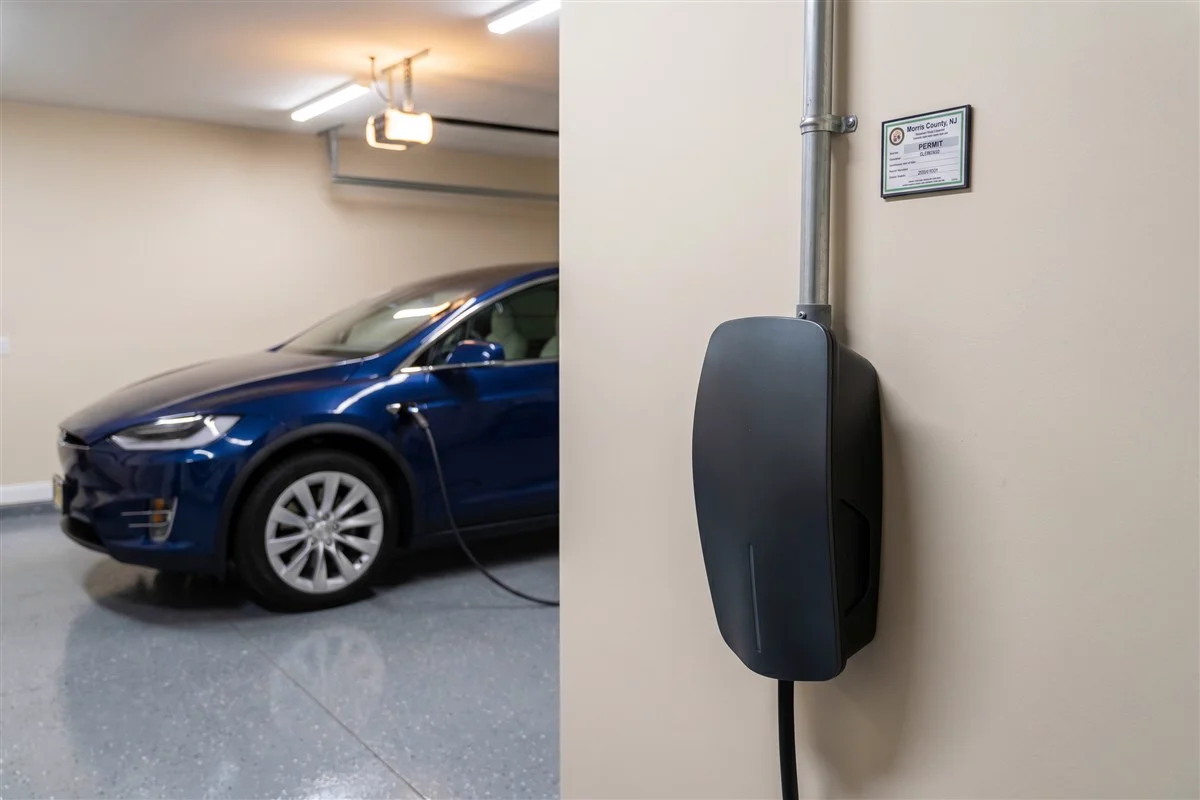
QMerit certified electrician installing Level 2 EV charger in Morris County NJ residential garage
Installation Checklist

What Your Morris County Home Needs for Level 2 EV Charging

Level 2 home EV charging starts with a licensed electrical assessment. Most Morris County homeowners are ready to go with minimal prep work — here's what Protocol evaluates on every installation visit before we run a wire.

  • Charging on a 120V outlet today (Level 1)? — A Level 2 dedicated circuit delivers 25–30 miles of range per hour vs. 3–5 on 120V. Your installation adds a dedicated 240V/50A circuit from panel to garage — a single-day job in most Morris County homes.
  • Your panel capacity is the first thing we evaluate — A Level 2 charger draws 40–50 amps continuously. Protocol checks your panel's available capacity under NEC Article 230 before sizing the circuit. If your 100A panel is at capacity, we'll tell you upfront with a clear quote for the panel upgrade path.
  • Permit is required — and included in every Protocol installationNEC Article 625 and the NJ Uniform Construction Code require an electrical permit for every new 240V EV circuit in Morris County. Protocol pulls the permit, schedules the municipal inspection, and handles the paperwork. You don't manage any of it.
  • No existing 240V garage outlet? — Most Morris County garages don't have one. Protocol runs a dedicated 240V/50A circuit from your main panel using 6 AWG copper per NEC 240.4 — routed cleanly through walls or attic, no exposed surface wiring.
  • Choosing between hardwired charger and NEMA 14-50 outlet — Hardwired smart chargers (ChargePoint Home Flex, Tesla Wall Connector, JuiceBox) mount directly to the wall and offer WiFi and time-of-use scheduling. A NEMA 14-50 outlet gives you flexibility to swap charger brands in the future. Protocol installs both — we'll talk through the tradeoff based on your vehicle and daily usage.
  • Adding a second EV? — Two Level 2 circuits require load management planning. Protocol evaluates panel capacity for simultaneous charging and, if needed, recommends an energy management device that prevents both chargers from drawing peak load at the same time.
  • Also adding a hot tub or spa? — Hot tubs require a dedicated 240V/50A or 60A circuit under NEC Article 680 — the same panel capacity calculation that governs EV charger installs. If you're adding both, Protocol handles both circuits in a single project. See our hot tub wiring service for what NEC 680 compliance requires.
  • Want backup power during outages? — Homeowners adding EV charging often ask about pairing it with a whole-house generator. Protocol installs both under one project — generator, automatic transfer switch, and EV circuit — so your car stays charged even when JCP&L goes out.
  • Older Morris County home (pre-1985)? — Colonials and split-levels in Dover, Wharton, Mine Hill, and Rockaway Borough built before 1985 often have FPE or Zinsco panels known to fail under high continuous loads. Protocol always evaluates panel type during the site assessment — if replacement is needed before EV installation, we'll tell you before any work begins.
  • Commercial fleet charging? — Businesses in Morris County installing EV charging for employee or fleet vehicles need commercial electrical service coordination, including three-phase load analysis, utility coordination, and commercial-grade EVSE installation. Protocol handles the full commercial EV scope.
  • Smart charger setup included — For ChargePoint, Tesla Wall Connector, and JuiceBox installations, Protocol completes WiFi configuration, app pairing, and off-peak scheduling setup. A full test charge cycle runs before we leave — you drive away charging immediately.
⚠ Federal Pacific & Zinsco Panels — Important Safety Note

Many Morris County homes built before 1990 still have Federal Pacific Electric (Stab-Lok) or Zinsco panels. These panels are known to fail under sustained high-amperage loads — exactly the condition created by a Level 2 EV charger drawing 40 to 50 amps. Under NEC Article 230, adequate service entrance capacity is required before adding a new branch circuit. Protocol always includes a panel evaluation in every EV charger installation quote — if your panel cannot safely support the load, we will tell you before we start, not after. If your panel is sparking or shows signs of active failure, that is a different situation — call our 24/7 emergency electrician line immediately at (908) 878-6479.

What We Install

EV Charging Services — Morris County, NJ

Every installation is permit-pulled, inspection-passed, and QMerit certified. NJ Electrical License #17230.

Level 2 Charger Installation (240V / 50A)

The industry standard for home EV charging. A dedicated 240V / 50A circuit delivers 25 to 30 miles of range per hour — a full charge overnight regardless of battery size. Protocol installs Level 2 systems for all major EV makes in compliance with NEC Article 625. Recommended for any Morris County homeowner with a daily commute or multi-driver household.

NEMA 14-50 Receptacle Installation

Prefer a portable EVSE rather than a hardwired unit? Protocol installs NEMA 14-50 outlets — the standard 240V / 50A receptacle compatible with most portable Level 2 chargers and Tesla Mobile Connectors. Future-proof: the same outlet supports portable chargers today and a hardwired smart charger later. Conductor sizing installed per NEC 240.4 for full 50-amp capacity.

Dedicated 240V Circuit — Panel to Garage

Every Level 2 install requires a dedicated branch circuit run from your main panel to the garage. Protocol pulls the correct wire gauge per NEC 240.4, installs AFCI protection per NEC 210.12, and routes through finished walls, attics, or conduit as the home requires — no exposed wiring shortcuts. Permit pulled with Morris County before any wire is run.

Smart Charger Setup — ChargePoint, Tesla & JuiceBox

Protocol installs and configures the leading smart home EV chargers: ChargePoint Home Flex, Tesla Wall Connector, and Enel X JuiceBox. WiFi-enabled units allow time-of-use scheduling — charge during JCP&L or PSE&G off-peak hours to reduce your monthly electric bill. Energy monitoring shows exactly how many kWh each session consumed. App setup and connectivity verification included with every installation.

Panel Evaluation & Upgrade Path

A Level 2 EV charger adds 40 to 50 amps of sustained load. Protocol's licensed electricians evaluate your current panel capacity, existing circuit loads, and service entrance rating under NEC Article 230 before sizing the EV circuit. If your 100-amp panel needs a 200-amp upgrade, we provide a full quote — no surprise add-ons at job completion. Panel evaluation is always included at no charge in your EV installation estimate.

QMerit Certified Installation

Protocol is a QMerit Certified EV Charger Installer — the national certification standard used by ChargePoint, GM Energy, Ford, Rivian, and other major EV manufacturers to validate installer quality. QMerit certification means your installation is performed by a vetted, licensed electrician and is documented for manufacturer warranty eligibility. Many EV charger warranties require QMerit-certified installation to remain valid — ask your charger manufacturer before choosing a non-certified installer.

Rebates & Financing

JCP&L & PSE&G EV Charger Rebates Available

JCP&L and PSE&G customers may qualify for rebates of up to $250 on qualifying Level 2 EV charger installations. The NJ Clean Energy Program offers additional incentives for residential EV infrastructure. Protocol provides the QMerit certification documentation your charger manufacturer requires and the utility rebate paperwork your JCP&L or PSE&G account needs. We also offer 0% financing on EV charger installations. Call (908) 878-6479 to confirm your rebate eligibility before scheduling.

Call (908) 878-6479 — Confirm Rebate Eligibility Request Free Estimate
Google Reviews

What Our Clients Say

Trusted by Morris County Homeowners

Read All Reviews on Google
What to Expect

How EV Charger Installation Works — Morris County, NJ

  1. Site Assessment

    A licensed Protocol electrician (NJ #17230) visits your home to evaluate panel capacity, available breaker space, garage layout, and the optimal route for the new circuit. This includes a full NEC Article 625 compliance review and an assessment of whether your current service entrance under NEC Article 230 can support the EV load without a panel upgrade. The assessment is included in your free estimate — no charge for the evaluation visit.

  2. Permit Application

    Protocol pulls the required Morris County electrical permit before any work begins. New EV charging circuits are classified as new branch circuit installations under the NJ Uniform Construction Code and require a permit in every Morris County municipality. The permit is filed with the local Construction Office and the NJ Board of Examiners of Electrical Contractors on record.

  3. Circuit Installation

    Protocol runs a dedicated 240V / 50A circuit from your main panel to the garage using wire sized per NEC 240.4 — typically 6 AWG copper for a 50A circuit. AFCI protection is installed per NEC 210.12. Wiring is routed cleanly through walls, attic space, or conduit — no surface-mounted exposed wire shortcuts.

  4. Charger Mounting & Activation

    Your EV charger is wall-mounted at the correct height and orientation for your vehicle's charge port location. For smart chargers (ChargePoint Home Flex, Tesla Wall Connector, JuiceBox), Protocol completes the WiFi configuration, app pairing, and time-of-use scheduling setup. A full test charge cycle is run before the electrician leaves — we confirm the charger communicates with your vehicle before job sign-off.

  5. Municipal Inspection & QMerit Certification

    The Morris County municipal electrical inspector conducts the required final inspection of the new circuit and charger installation. Once the inspection passes, Protocol issues the QMerit certification for your installation — the documentation required by most EV charger manufacturers to validate warranty coverage. We also provide the completed rebate documentation for JCP&L or PSE&G customers so you can submit your rebate claim without additional steps.

Common Questions

EV Charger Installation FAQs — Morris County, NJ

How much does it cost to install a Level 2 EV charger in NJ?

Most Level 2 EV charger installations in Morris County NJ run between $500 and $1,200 for a straightforward garage circuit — panel has capacity, short run from panel to install location, no drywall work required. That range covers the dedicated 240V / 50A circuit, permit, inspection, and charger mounting. Cost rises when the panel is at or near capacity (requiring a 100A to 200A upgrade), the circuit run is long, or conduit must be installed through finished space. Protocol includes a free panel evaluation in every quote so there are no surprises after work begins. Call (908) 878-6479 for a no-obligation estimate specific to your home.

What is the difference between Level 1, Level 2, and DC fast charging at home?

Level 1 charging uses a standard 120V household outlet — no installation required, but it delivers only 3 to 5 miles of range per hour, meaning a depleted 75 kWh battery pack takes 30 to 40 hours to fully charge. Level 2 uses a dedicated 240V circuit (the same voltage as your dryer or oven) and delivers 25 to 30 miles of range per hour — a full charge in 6 to 10 hours overnight. DC fast charging (Level 3) operates at 480V DC and is a commercial technology — it is not installable in residential homes and requires utility-grade transformer infrastructure.

Do I need a permit to install an EV charger in Morris County, NJ?

Yes — always. Any new 240V branch circuit installed in a Morris County home requires an electrical permit under the NJ Uniform Construction Code. This applies whether you are installing a hardwired Level 2 charger or simply adding a NEMA 14-50 outlet in the garage. Protocol pulls the permit for every installation. Any installer who offers to "skip the permit to save money" is exposing you to significant liability.

What is QMerit certification and why does it matter for my EV charger installation?

QMerit is the national third-party installer certification platform used by ChargePoint, GM Energy, Ford Pro, Rivian, Wallbox, and other EV manufacturers to vet and verify the electricians they recommend to customers. More critically, several major EV charger manufacturers require QMerit-certified installation to honor the product warranty — a non-certified install can void coverage. Protocol is a QMerit Certified EV Charger Installer, which means our work meets the national standard those manufacturers require. We provide the QMerit certificate with every completed installation.

Will my existing 100-amp panel support a Level 2 EV charger?

It depends on your existing load. A Level 2 charger on a 50-amp circuit consumes up to 9.6 kW continuously — a substantial load for a 100-amp panel already serving a modern home's appliances, HVAC, water heater, and lighting. Protocol's site assessment evaluates your actual connected load versus available panel capacity under NEC Article 230 requirements. If a panel upgrade is needed, we will tell you upfront with a clear quote — not as a surprise after installation begins.

Which EV chargers does Protocol install — ChargePoint, Tesla, JuiceBox?

Protocol installs all major residential Level 2 EV chargers, including ChargePoint Home Flex, Tesla Wall Connector (compatible with all EV brands via the J1772 adapter), Enel X JuiceBox, Emporia, and Grizzl-E. As a QMerit Certified installer, Protocol is qualified to install chargers sold through manufacturer referral programs from ChargePoint, GM, Ford, and Rivian. If you have already purchased a specific charger, call (908) 878-6479 and we will confirm compatibility before scheduling.

How long does an EV charger installation take?

A straightforward Level 2 EV charger installation — panel has capacity, garage is attached, circuit run is under 50 feet — typically takes 2 to 4 hours from arrival to test charge. The municipal electrical inspection is scheduled separately by the town and typically happens within 3 to 10 business days after installation. Protocol handles the inspection scheduling — you do not need to coordinate with the town.

Can I get a rebate from JCP&L or PSE&G for my EV charger installation in Morris County?

Yes — both JCP&L and PSE&G have offered residential EV charger rebate programs, typically providing up to $250 back on qualifying Level 2 charger installations. Rebate availability and program terms change seasonally, so Protocol confirms current program status for every customer before scheduling. QMerit certification documentation — which Protocol provides with every installation — is required by most utility rebate programs to verify installer qualification.

Is it safe to use an extension cord to charge my electric vehicle?

No — and it is explicitly prohibited by the NEC. NEC Article 625, the dedicated national standard for electric vehicle charging equipment, prohibits the use of extension cords with EV charging equipment. EV charging draws sustained high amperage over many hours — a load that standard household extension cords are not rated for and cannot safely carry. If your garage outlet is too far from your vehicle's charge port, the correct solution is a properly installed circuit extension by a licensed electrician — not an extension cord.

What does NEC Article 625 require for home EV charger installations?

NEC Article 625 is the National Electrical Code's dedicated article covering electric vehicle power transfer systems. Key requirements include: a dedicated branch circuit sized for the charger's maximum output, conductor sizing per NEC 240.4 at 125% of the continuous load, AFCI protection per NEC 210.12, listed equipment (UL-listed charger), prohibition of extension cord use, and disconnecting means within sight of the charger.

Protocol Services - Electric & Air

350 US-46 Suite 217
Rockaway, NJ 07866
(908) 878-6479

24/7 Emergency Electrical Service
Licensed · Bonded · Insured
NJ Electrical License #17230

QMerit Certified EV Installer  ·  Generac Dealer
Carrier Dealer  ·  Rheem Dealer
Serving Morris County Since 2011

View on Google Maps Call (908) 878-6479

About Morris County, NJ

Morris County stretches along Route 46, I-80, and Routes 202/206 — corridors lined with mid-century colonials, split-levels, and Cape Cods built primarily between 1955 and 1985. Towns like Dover, Wharton, Mine Hill, and Rockaway Borough carry high concentrations of older Federal Pacific Electric and Zinsco panels that were installed during that era and are now well past service life. Lakefront neighborhoods — White Meadow Lake, Lake Telemark, Indian Lake, and Hibernia — see a mix of seasonal cottages and year-round homes, many with outdated 100-amp service that can't support modern loads. Affluent communities like Denville, Randolph, and Parsippany-Troy Hills drive strong demand for 200-amp upgrades to support Level 2 EV chargers, Generac standby generators, and heat pump systems from Carrier, Mitsubishi, and Fujitsu. Landmarks like Jockey Hollow National Historical Park, the Great Swamp National Wildlife Refuge, and Lake Hopatcong — NJ's largest lake — anchor a county where older infrastructure and modern energy demands meet head-on.

Morris County Communities We Serve

Outside this list? Call (908) 878-6479 — we serve all of Northern NJ.

Ready to Install Your EV Charger?

QMerit Certified. Permit-included. JCP&L and PSE&G rebates available. NJ License #17230.

Call (908) 878-6479 Request Free Estimate
Scroll to Top
This site is protected by reCAPTCHA and the Google Privacy Policy and Terms of Service apply.