
Commercial Lighting Contractor Morris County NJ —
LED Retrofits & NEC 700 Compliance
Protocol Services - Electric & Air installs commercial LED lighting systems, emergency egress fixtures, and occupancy controls for Morris County businesses — with JCP&L SmartStart rebate processing and full NEC 700 code compliance. NJ License #17230.
NJ Electrical License #17230. Off-hours and phased scheduling available to keep your business running. 100% satisfaction guarantee on every job.
Protocol Services - Electric & Air is the commercial electrical contractor Morris County NJ businesses call for LED retrofits, emergency egress installations, and occupancy control systems. We serve warehouses and distribution centers along the Route 46/10 corridor, office parks in Parsippany and Rockaway, retail spaces at Rockaway Townsquare, and parking lots throughout the county — installing DLC-listed luminaires under NEC Article 410 with permits pulled and inspections scheduled on every project. From a 10-fixture office retrofit in Denville to a 200-fixture high-bay warehouse job in Wharton, Protocol handles the full scope: photometric design, permit filing, installation, and post-installation testing.
Commercial LED lighting upgrades in Morris County carry a financial case that most contractors never explain. Jersey Central Power & Light's SmartStart Buildings Program offers prescriptive rebates up to $450 per DLC-listed fixture for businesses in JCP&L territory — Rockaway, Dover, Wharton, Mine Hill, Boonton, and Lincoln Park. PSE&G's Business Energy Saver Program covers Parsippany, Denville, and Mountain Lakes with rebates from $5 to $525 per fixture. On top of utility rebates, projects that reduce Lighting Power Density by 25% or more versus the ASHRAE 90.1 baseline may qualify for the federal 179D Commercial Buildings Energy Efficiency Tax Deduction — up to $5.36 per square foot under the Inflation Reduction Act of 2022. Protocol identifies the correct utility rebate program for each client's service territory, specifies only DLC-listed fixtures for every project, and handles all rebate paperwork from application to payment.
Code compliance is not optional for Morris County commercial properties. Every luminaire Protocol installs complies with NEC Article 410 — UL-listed fixtures rated for their wet, damp, or dry application. Commercial occupancies in New Jersey are also required under NEC Article 700 and NFPA 101 to maintain emergency egress lighting that activates within 10 seconds of a power failure and sustains 1 foot-candle average illumination on egress paths for 90 minutes. Protocol installs, tests, and certifies complete NEC 700 emergency lighting systems — including monthly and annual NFPA 101 test documentation — giving Morris County property managers the paperwork they need for certificates of occupancy and AHJ inspections. Many commercial lighting projects also require a panel upgrade to support the new load or add dedicated lighting circuits, and businesses investing in fleet electrification can bundle EV charging infrastructure into the same permitted project. For all commercial and residential electrical services, visit our Morris County electrical services hub.
Commercial Lighting Services — Morris County NJ
JCP&L SmartStart Rebate Processing
Protocol handles all JCP&L SmartStart Buildings rebate paperwork for Morris County businesses in JCP&L territory (Rockaway, Dover, Wharton, Mine Hill, Boonton, Lincoln Park). We specify only DLC-listed fixtures on every project — the requirement for prescriptive rebates up to $450 per fixture. You receive a net-cost project, not a reimbursement promise.
NEC 700 Emergency Egress Systems
NEC Article 700 and NFPA 101 require emergency egress lighting in all NJ commercial occupancies — power-on within 10 seconds of failure, 1 foot-candle minimum on egress paths, 90-minute battery backup. Protocol installs LED exit signs and egress battery units, performs NFPA 101 monthly and annual tests, and provides the written test certifications Morris County building officials require for CO sign-off.
LED High-Bay Retrofits (Warehouses)
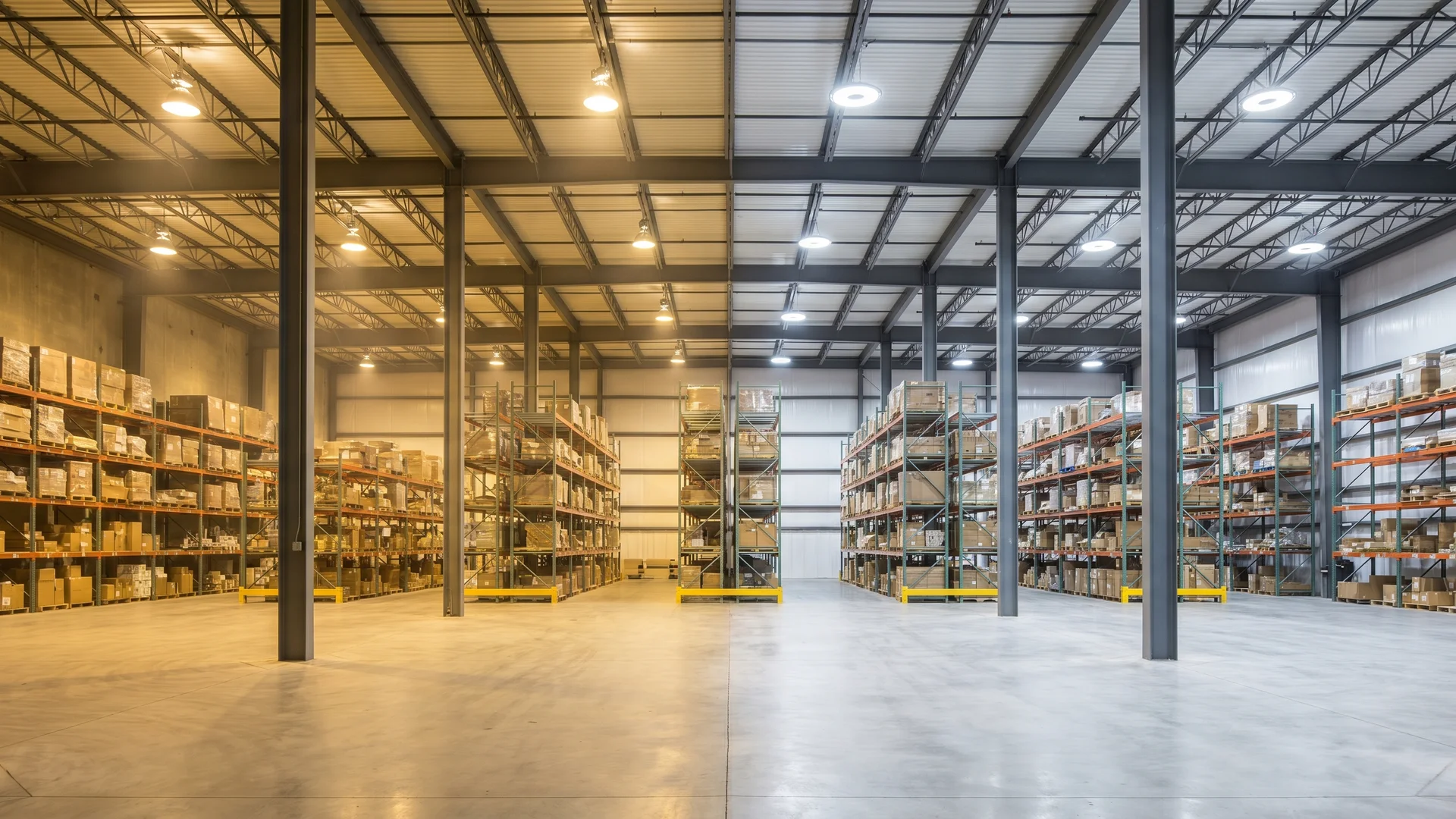
Warehouses and distribution centers on the Route 46/10 corridor run 400W metal halide fixtures that consume three times the energy of modern LED equivalents. Protocol replaces them with DLC-listed UFO and linear LED high-bays sized for 15–40 ft ceiling heights — delivering IES-compliant foot-candle levels, 50–70% energy reduction, and JCP&L SmartStart rebates up to $400 per fixture. Photometric analysis provided before installation.
LED Troffer Retrofits (Offices)
Office parks in Parsippany, Rockaway, and Denville still running T8 or T12 fluorescent troffers are leaving rebate money and energy savings on the table. Protocol installs 2×4 and 2×2 DLC-listed LED troffers at 4000K neutral CCT, achieving the 30–50 foot-candle task illumination IES recommends for offices. Occupancy and daylight sensors are added per ASHRAE 90.1 NJ energy subcode requirements — delivering 20–60% additional savings beyond the LED upgrade alone.
Parking Lot LED Lighting
Protocol replaces HPS sodium shoebox area lights with DLC-listed LED equivalents meeting IES RP-8 foot-candle targets (1–2 fc for open lots). Photocell dusk-to-dawn controls are standard. We mount to existing poles or install new steel poles — and specify DLC Premium fixtures for maximum JCP&L and PSE&G rebate eligibility. LED wall packs at building perimeters are included in exterior lighting assessments.
179D Tax Deduction Documentation
The federal 179D Commercial Buildings Energy Efficiency Tax Deduction provides up to $5.36 per square foot for projects that reduce Lighting Power Density by 25% or more versus the ASHRAE 90.1 baseline. Protocol documents pre- and post-retrofit LPD calculations in the format required for IRS Form 7205, so your tax advisor can claim the deduction without reconstructing the project numbers after the fact.
Commercial Lighting by Application — Morris County NJ
Different commercial spaces have different illumination requirements under IES standards and different rebate opportunities based on their utility service territory. Protocol designs each project to the application.
Warehouse & Distribution — Route 46/10 Corridor
Warehouses with ceiling heights of 15 to 40 feet require LED high-bay luminaires — UFO-style for general bay lighting, linear high-bays for row-and-rack configurations. A 150W DLC-listed LED UFO high-bay replaces a 400W metal halide fixture and delivers equivalent or greater foot-candle output at the work plane, measured against IES recommendations of 20–30 fc for warehouse environments. The energy reduction runs 50–70%. In JCP&L territory — which covers Rockaway, Dover, Wharton, and Mine Hill — DLC-listed high-bays qualify for SmartStart prescriptive rebates up to $400 per fixture. Dover and Wharton industrial buildings frequently carry aging T12 fluorescent stock in ancillary spaces alongside metal halide in main bays; Protocol addresses both in a single project scope.
Office & Office Park — Parsippany, Rockaway, Denville
Drop-ceiling office environments use 2×4 or 2×2 LED troffers as the primary luminaire. Protocol specifies DLC-listed retrofit kits and full fixture replacements at 4000K CCT, calibrated to IES-recommended 30–50 foot-candles for general office task areas. ASHRAE 90.1 — adopted into the NJ energy subcode — requires occupancy sensors in private offices, conference rooms, and restrooms. Protocol installs occupancy and daylight sensors as part of every office retrofit, layering 20–60% additional savings on top of the LED efficiency gain. Parsippany-Troy Hills, which carries the largest commercial tax base in Morris County with office parks such as Morris Corporate Center, falls in PSE&G service territory — qualifying for PSE&G Business Energy Saver rebates of $5 to $525 per DLC-listed fixture. Protocol identifies the correct utility for each project address before procurement so rebate eligibility is confirmed before any fixture is ordered.
Retail — Rockaway Townsquare & Route 46 Corridor
Retail lighting demands high Color Rendering Index — CRI 90 or above — so merchandise colors appear accurate under artificial light. Protocol specifies CRI 90+ LED fixtures at 3500K–4000K CCT for retail ambient layers, supplemented by LED track lighting and accent fixtures for merchandising displays. Rockaway Townsquare and Route 46 retail properties benefit from the energy savings and rebate programs available to all commercial accounts in JCP&L territory, and the improved light quality directly supports the visual merchandising environment. Emergency egress compliance under NEC Article 700 is addressed in every retail installation — retail occupancies with customer-facing spaces are among the most actively inspected for egress lighting compliance by Morris County building officials.
Parking Lot & Exterior — All Morris County Municipalities
IES RP-8 sets the foot-candle targets for parking areas: 1–2 fc average for open surface lots, higher for structured parking. Protocol designs parking lot lighting to IES RP-8 minimums using DLC-listed LED shoebox area lights on existing poles or new steel poles as the layout requires. Photocell dusk-to-dawn controls are standard on all pole-mounted fixtures. At building perimeters, LED wall packs replace aging incandescent and HPS equivalents. DLC Premium fixture specifications unlock maximum rebate tiers for parking area fixtures under both JCP&L SmartStart and PSE&G Business Energy Saver, and the 60–75% energy reduction on parking lot lighting delivers measurable annual operating savings across properties with large surface lots.
LED Retrofit ROI for Morris County Businesses
The financial case for commercial LED upgrades in Morris County combines three separate revenue streams — utility rebates, federal tax deductions, and ongoing energy savings. Here is a worked example using a mid-size warehouse, which represents the most common project type Protocol handles on the Route 46/10 corridor.
Example: 20,000 Sq Ft Warehouse — 50 Fixtures (JCP&L Territory)
Existing: 50 × 400W metal halide high-bays
Replacement: 50 × 150W DLC-listed LED UFO high-bays
| ROI Component | Calculation | Value |
|---|---|---|
| Annual Energy Savings | 12,500W reduction × 4,000 hrs/yr = 50,000 kWh saved × $0.14/kWh | $7,000/yr |
| JCP&L SmartStart Rebate | 50 DLC-listed fixtures × up to $400/fixture (prescriptive) | Up to $20,000 |
| 179D Federal Tax Deduction | 25%+ LPD reduction on 20,000 sq ft × up to $5.36/sq ft | Up to $107,200 |
| Estimated Simple Payback | After rebates and deduction; energy savings cover remaining cost | 2–4 years typical |
Rebate amounts are subject to program availability and DLC listing verification. The 179D deduction requires a qualified energy study and IRS Form 7205 — consult your tax advisor. Protocol documents the LPD calculations required for the deduction claim. Energy savings calculated at $0.14/kWh; actual savings vary by rate class and operating hours.
Small Office Comparison (Parsippany, PSE&G Territory)
A 5,000 sq ft office replacing 30 × 2×4 fluorescent troffers with DLC-listed LED equivalents qualifies for PSE&G Business Energy Saver rebates and potentially the 179D deduction if LPD reduction exceeds 25%. Add occupancy sensors (also rebated by PSE&G) and total energy reduction in the lighting circuit commonly reaches 65–75% versus the fluorescent baseline. Protocol identifies PSE&G vs. JCP&L service territory by project address — Parsippany, Denville, and Mountain Lakes are PSE&G; Rockaway, Dover, and Wharton are JCP&L — before specifying any fixtures, so every project is optimized for its actual rebate program from day one.
Trusted by Morris County Homeowners
Real reviews from Rockaway, Dover, Wharton, and surrounding communities.
How Protocol Handles Commercial Lighting Projects
Commercial Lighting Assessment
Protocol surveys all existing fixtures and measures current foot-candle levels against IES recommendations for your application — warehouse, office, retail, or parking. We identify whether your address falls in JCP&L or PSE&G service territory, calculate the rebate programs available to your project, and produce a written ROI projection before any proposal is signed. If 179D eligibility is likely based on scope, we flag it at this stage so your tax advisor can be looped in early.
Photometric Design
Protocol produces a computer-generated foot-candle analysis using IES photometric files from the specified DLC-listed fixtures. The photometric plan confirms that target illumination levels — 20–30 fc for warehouses, 30–50 fc for offices, IES RP-8 for parking — are met before a single fixture is ordered. This step also produces the layout documentation required for permit applications and rebate pre-approvals.
Permit Application & Rebate Pre-Approval
Protocol files the commercial lighting permit with the local Morris County municipality — Rockaway, Parsippany, Dover, Wharton, Denville, or the applicable jurisdiction. Simultaneously, we submit the JCP&L SmartStart or PSE&G Business Energy Saver pre-approval application. If the scope includes NEC Article 700 emergency lighting, that work is included in the permit application as a separate line item. Protocol manages all permit and rebate correspondence; you do not need to interface with the utility or building department.
Installation
DLC-listed LED luminaires are installed under NEC Article 410 — UL-listed fixtures with wet, damp, or dry ratings matched to their installed environment. Emergency egress systems are installed under NEC Article 700: LED exit signs, 90-minute battery backup egress luminaires, and circuit wiring to a dedicated emergency branch circuit. Occupancy sensors are wired per ASHRAE 90.1 in private offices, conference rooms, and restrooms. For occupied commercial spaces, Protocol phases installation to keep the facility operational throughout the project.
Testing, Inspection & Rebate Submission
Protocol performs NFPA 101 emergency lighting tests — a 30-second functional test confirming activation and a 90-minute full battery discharge test confirming sustained illumination — and delivers written test certifications. The electrical inspector signs off on the completed installation. Protocol then submits the final JCP&L or PSE&G rebate package, including DLC listing documentation, pre- and post-installation fixture counts, and energy calculations. For projects pursuing the 179D deduction, we deliver pre- and post-retrofit LPD calculations in the format required for IRS Form 7205.
Commercial Lighting — Frequently Asked Questions
How much does commercial LED lighting installation cost in NJ?
Project cost varies significantly by scope. A small office replacing 10–20 fixtures typically runs $2,000–$8,000 before rebates. A large warehouse with 50–200 high-bay fixtures commonly ranges from $10,000 to $50,000 or more depending on fixture count, ceiling height, and whether new electrical circuits are required. JCP&L SmartStart rebates — up to $450 per DLC-listed fixture for Morris County businesses in JCP&L territory — significantly reduce net project cost. PSE&G Business Energy Saver rebates serve Parsippany, Denville, and Mountain Lakes. Protocol provides a written ROI projection that shows gross cost, rebate offset, and simple payback period before you commit to a project.
Does NJ have rebates for commercial LED lighting upgrades?
Yes — two utility programs serve Morris County, and which one applies depends on your address. Jersey Central Power & Light's SmartStart Buildings Program provides prescriptive rebates up to $450 per DLC-listed LED fixture for businesses in JCP&L territory (Rockaway, Dover, Wharton, Mine Hill, Boonton, Lincoln Park). PSE&G's Business Energy Saver Program covers Parsippany, Denville, and Mountain Lakes with rebates from $5 to $525 per DLC-listed fixture depending on fixture type. In some scenarios, the NJ Clean Energy Program's SmartStart Buildings can stack with utility rebates for additional savings. Protocol identifies the correct program for your service territory and handles all paperwork — application, DLC documentation, and post-installation rebate submission.
Do commercial buildings in NJ need emergency lighting?
Yes. NEC Article 700 and NFPA 101 (the Life Safety Code) require emergency egress lighting in all commercial occupancies in New Jersey. The system must activate within 10 seconds of a power failure, provide a minimum average of 1 foot-candle along egress paths, and sustain that illumination for 90 minutes on battery backup. Exit signs must be illuminated at all times. Morris County building officials issue code violation notices for non-compliant emergency lighting systems, and certificates of occupancy can be withheld without proper installation and test documentation. Protocol installs, tests, and certifies complete NEC 700 emergency lighting systems — including the written NFPA 101 test certifications required for AHJ inspections.
Does emergency lighting require annual testing in NJ commercial buildings?
Yes. NFPA 101 requires two recurring tests for emergency lighting systems: a monthly 30-second functional test confirming that the system activates and maintains proper illumination, and an annual 90-minute full battery discharge test confirming the system can sustain the required 1 foot-candle on egress paths for the full backup duration. Both tests must be documented in writing. Protocol performs emergency lighting testing and certification for Morris County commercial clients and delivers the written test records building owners need for their maintenance files and AHJ inspections.
How long does a commercial LED retrofit take?
Timeline depends on project size and whether the space must remain occupied during installation. A small office replacing 10–20 fixtures typically completes in 1–2 days. A large warehouse with 100–200 high-bay fixtures generally runs 3–7 days, with Protocol phasing work by bay section to keep the facility operational throughout. Parking lot retrofits — swapping out pole-mounted shoebox fixtures — typically complete in 1–3 days depending on pole count. Permit approval timelines add 1–3 weeks before installation begins; Protocol files permits as early as possible in the project sequence to minimize the wait.
What is the difference between high-bay and low-bay lighting for warehouses?
The distinction is ceiling height. High-bay lighting is designed for spaces with ceilings 15 to 40 feet — standard for warehouses and distribution centers. LED UFO high-bays (100–300W) and linear high-bays are the modern replacement for 400W metal halide fixtures at these heights. Low-bay lighting applies to spaces under 15 feet, where linear LED strip fixtures and surface-mounted LED panels replace T8 or T12 fluorescent equivalents. Both high-bay and low-bay DLC-listed LED fixtures qualify for JCP&L SmartStart rebates in Morris County JCP&L territory. Protocol specifies the correct fixture type based on your ceiling height and IES foot-candle targets for your application.
What LED lighting is required for a commercial office in Morris County NJ?
The primary luminaire for drop-ceiling office spaces is the 2×4 or 2×2 LED troffer — the direct replacement for T8 fluorescent. IES recommends 30–50 foot-candles for general office task areas; Protocol's photometric design confirms the selected fixtures hit that target in your specific room layout. Color temperature of 4000K is standard for task-oriented workspaces. The NJ energy subcode (based on ASHRAE 90.1) requires occupancy sensors in private offices, conference rooms, and restrooms — these must be installed as part of any new or retrofit lighting project. Occupancy sensors also qualify for utility rebates and add 20–60% energy savings beyond the LED fixture upgrade.
Does commercial LED lighting qualify for a federal tax deduction?
Yes. The 179D Commercial Buildings Energy Efficiency Tax Deduction provides up to $5.36 per square foot (under the Inflation Reduction Act of 2022 enhanced rate) for commercial lighting projects that reduce Lighting Power Density by 25% or more versus the ASHRAE 90.1 baseline. IRS Form 7205 is required, and a qualified energy study must document the pre- and post-retrofit LPD values. A 10,000 sq ft Morris County commercial building qualifying at the maximum rate represents up to $53,600 in federal tax deductions — and a 20,000 sq ft warehouse could see up to $107,200. Protocol documents pre- and post-retrofit LPD calculations in the format your tax advisor needs to prepare Form 7205.
What is the JCP&L SmartStart rebate for commercial LED lighting?
The JCP&L SmartStart Buildings Program is Jersey Central Power & Light's commercial energy efficiency rebate for businesses in JCP&L service territory — which includes Rockaway, Dover, Wharton, Mine Hill, Boonton, and Lincoln Park in Morris County. The program offers prescriptive rebates for DLC-listed LED fixtures: up to $450 per interior fixture and up to $400 per LED high-bay. Rebates are also available for DLC-listed parking lot and exterior fixtures and for occupancy sensors. The program requires pre-approval before installation begins, DLC listing documentation for specified fixtures, and a post-installation verification. Protocol manages the entire process — pre-approval application, fixture specification, and final rebate submission — so the rebate is captured without adding project management burden to the client. The official program is administered through bizsolutions.energysavenj.com/instant-discounts/.
What commercial properties in Morris County most commonly need LED retrofits?
The highest-volume retrofit opportunities in Morris County fall into four categories. Warehouses and distribution centers on the Route 46/10 corridor — Rockaway, Dover, and Wharton — are running 400W metal halide high-bays that are 15–25 years old; these are the strongest ROI candidates because of the large per-fixture wattage reduction and the JCP&L SmartStart rebates available in that service territory. Office parks in Parsippany (PSE&G territory) and Rockaway (JCP&L territory) with T8 fluorescent troffers are the next largest segment. Retail spaces at Rockaway Townsquare and along Route 46 have retrofit needs driven by both energy cost and merchandise display quality. Parking lots throughout Morris County — particularly those still running HPS sodium — complete the picture. Protocol serves all four property types across all Morris County municipalities.
Commercial Lighting Service — Morris County, NJ
Licensed electricians (NJ #17230) serving Parsippany, Rockaway, Dover, Wharton, Denville, and all of Morris County since 2011. LED retrofits, emergency egress systems, and rebate processing under one licensed team.
Protocol Services - Electric & Air
350 US-46 Suite 217Rockaway, NJ 07866 (908) 878-6479
Commercial Lighting Contractor
Licensed · Bonded · Insured
NJ Electrical License #17230
JCP&L SmartStart Rebate Processing · NEC 700 Emergency Egress
LED High-Bay & Troffer Retrofits · 179D LPD Documentation
Serving Morris County Since 2011
Morris County Commercial Lighting Service Area
Morris County commercial properties stretch across the Route 46/10 corridor — from the industrial parks of Wharton and Dover through the office campuses of Parsippany-Troy Hills to the retail centers around Rockaway Townsquare. Warehouses in Rockaway Township and Wharton run aging metal halide high-bay systems that are prime candidates for LED retrofit with JCP&L SmartStart rebates. Office parks in Parsippany-Troy Hills, the county's largest commercial tax base, fall in PSE&G territory with their own rebate program. Retail along Route 46 and Mountain Lakes benefits from both energy savings and improved merchandise display quality under high-CRI LED. Protocol services commercial lighting across all 39 Morris County municipalities.
Morris County Communities We Serve
Outside this list? Call (908) 878-6479 — we serve all of Morris County and surrounding areas.
Other Electrical Services From Protocol
Commercial LED Lighting Contractor — Morris County NJ
Protocol Services - Electric & Air — NJ License #17230 — Licensed, bonded, and insured since 2011. JCP&L SmartStart rebate processing included at no extra cost. NEC 700 emergency egress systems installed and certified. Photometric design and 179D LPD documentation provided on qualifying projects. Serving Parsippany, Rockaway, Dover, Denville, Wharton, Mine Hill, Boonton, and all Morris County commercial properties.
Call 908-878-6479
Get Your Commercial Lighting Assessment