

Knob-and-Tube Wiring Replacement Morris County NJ
Serving Dover, Boonton, Wharton, Mine Hill, and all Morris County municipalities — insurance compliance documentation, NEC Article 394 certified replacement, and full rewire with 200-amp panel upgrade under NJ License #17230.
On qualifying projects. Soft credit check, approval in minutes, terms 24–84 months. Subject to credit approval.
Knob-and-tube wiring (Q922641) is a two-wire electrical system installed in American homes roughly from 1880 through the late 1940s. It uses individual copper conductors threaded through ceramic tube insulators drilled into floor joists and stapled to framing with porcelain knob insulators — with no ground conductor and no cable jacket. In Morris County, this wiring is still active in a significant number of pre-1940 homes in Dover, Boonton, Wharton, and Mine Hill, where the original construction dates to the iron-industry and early residential growth eras. The cloth-insulated conductors installed 80 to 100 years ago are now brittle, cracked, and incapable of safely serving the loads of a modern household. Protocol Services - Electric & Air holds NJ Electrical License #17230 and is the Morris County electrician that pre-1940 homeowners, real estate agents, insulation contractors, and energy auditors call when knob-and-tube wiring must be replaced.
Three events are bringing Morris County homeowners to us right now. First, homeowners insurance carriers — including Allstate, State Farm, Travelers, Citizens, and Liberty Mutual — are refusing to write new policies or non-renewing existing policies when knob-and-tube wiring is discovered. The New Jersey Department of Banking and Insurance (DOBI) issued Order A24-09 in December 2024 requiring all property and casualty insurers operating in NJ to submit their homeowners underwriting guidelines, a direct signal that insurance denials tied to outdated wiring are under regulatory scrutiny. Second, energy efficiency upgrades are triggering mandatory replacement: NEC Article 394.12(5) flatly prohibits knob-and-tube wiring in any space that contains blown-in, rolled, or foamed-in thermal insulation — and energy auditors and insulation contractors throughout Morris County routinely discover active K&T that must be replaced before attic insulation work can proceed. Third, home sales in pre-1940 Dover, Boonton, and Wharton neighborhoods require seller disclosure of known knob-and-tube wiring as a material defect under New Jersey law, and most buyers request remediation before closing.
Knob-and-tube replacement is not a simple swap of a few wires. It is a comprehensive project: Protocol replaces all cloth-insulated K&T conductors with modern NM-B copper cable (Romex), upgrades the existing 60-amp fused service to a 200-amp panel upgrade, installs AFCI breakers throughout per NEC 210.12, and adds GFCI protection at all required wet-location circuits per NEC 210.8. For homes with aluminum branch wiring in addition to K&T, a full house rewiring may be required to address all hazardous conductors in a single permitted project. Every K&T replacement project is permitted through the applicable Morris County municipality — Dover, Boonton, Wharton, Mine Hill, Rockaway, Lincoln Park, or wherever the home is located — and Protocol schedules the required rough and final electrical inspections. When work is complete, we deliver a signed inspection document and insurance compliance letter that NJ homeowners carriers accept as proof of remediation. Cost for a typical Morris County home ranges from $10,000 to $25,000 depending on square footage, with most projects landing at $5 to $15 per square foot including the 200-amp panel upgrade.
If your home has isolated damaged circuits rather than a full K&T system, our electrical repair service can address targeted wiring issues without a full replacement project. For a full list of our Morris County electrical services, including house rewiring, panel upgrades, generator installation, and more, visit our electrical services hub.
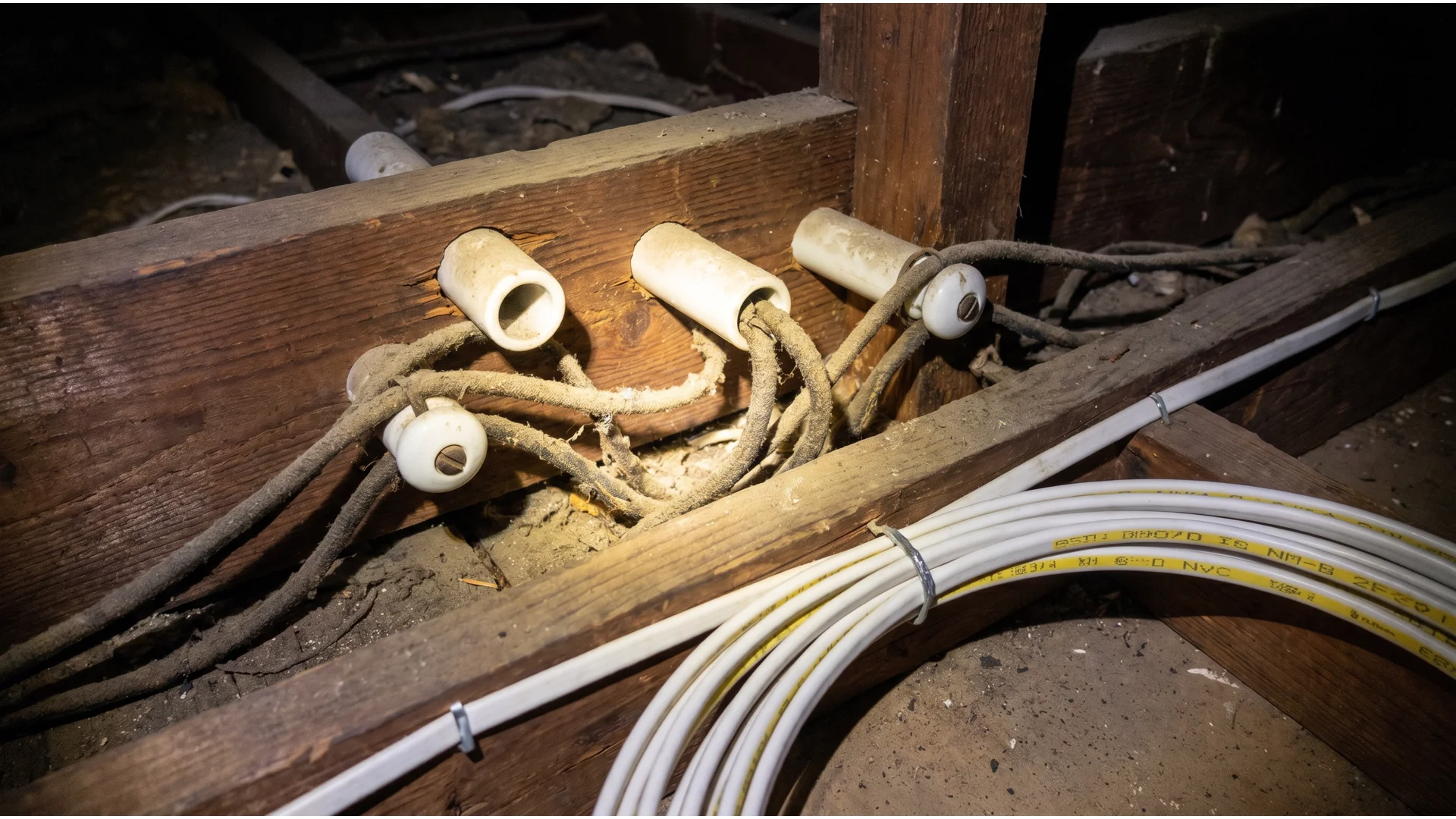
Full K&T Replacement — Six Deliverables
Every knob-and-tube replacement project from Protocol includes these six components — not just the wire swap.
Insurance Compliance Documentation
When your NJ homeowners carrier — Allstate, State Farm, Travelers, Citizens, or Liberty Mutual — refuses a new policy or flags an existing policy for non-renewal because of knob-and-tube wiring, the obstacle is documentation. Protocol provides a signed inspection report and written compliance letter confirming that all K&T wiring has been replaced, inspected, and approved by the municipal electrical inspector under NEC 2020. This is the document your insurance carrier requires before issuing a new policy. We coordinate directly with the municipal building department to ensure the certificate of electrical approval is ready for your insurer without delay.
NEC Article 394 — Code Compliance
New Jersey operates under NEC 2020. NEC Article 394.12(5) prohibits knob-and-tube wiring in any concealed space where blown-in, rolled, or foamed-in thermal insulation is present. Energy auditors working in Dover, Boonton, and Wharton attics encounter this prohibition constantly — they cannot legally install insulation over active K&T. Protocol is the licensed electrician Morris County insulation contractors call to clear the wiring before the energy efficiency project proceeds. We also field calls from homeowners whose insulation contractor has stopped mid-job upon discovering K&T they didn't know was there. We schedule around your contractor timeline so your insulation project stays on track. If your project is a broader home renovation — addition, gut-renovation, or whole-floor remodel — our renovation electrical service covers the full scope from K&T remediation through new circuit installation and final inspection.
Full Rewire with NM-B Copper Cable
Knob-and-tube wiring cannot be patched or supplemented — it must be replaced entirely. Protocol removes all cloth-insulated K&T conductors and replaces them with Type NM-B nonmetallic-sheathed copper cable: 14/2 for 15-amp circuits, 12/2 for 20-amp circuits, and larger conductors where required by load. In finished Morris County homes — the plaster-wall Victorians in Boonton, the craftsmen bungalows in Wharton, the brick colonials in Dover — our crews use fish-wire technique to thread new cable through walls and floors with minimal disruption to existing plaster and drywall. Where concealed runs are not feasible, we discuss surface conduit as a clean and code-compliant alternative before any work begins.
200-Amp Panel Upgrade Included
Homes with knob-and-tube wiring almost universally have 60-amp fused electrical service — a panel capacity that cannot safely power a modern home's HVAC system, electric range, EV charger, or simultaneous appliance loads. K&T replacement at Protocol always includes upgrading the service panel to a 200-amp circuit breaker panel with AFCI protection throughout per NEC 210.12 and GFCI protection at all kitchen, bathroom, garage, and outdoor circuits per NEC 210.8. The result is a complete electrical system — new wiring, new panel, new code-compliant protection — rather than old K&T conductors feeding a new breaker box. We pull the required service upgrade permit as part of the overall project permit application.
Real Estate Transaction Support
New Jersey requires sellers to disclose known knob-and-tube wiring as a material defect under NJ real estate disclosure law. When home inspectors flag K&T during a pre-sale or pre-purchase inspection of a Dover, Boonton, Wharton, or Mine Hill property, the transaction timeline compresses fast. Protocol serves Morris County buyers, sellers, and realtors who need K&T replacement completed before a closing date. We coordinate directly with realtors on project scheduling, provide written documentation of work completed and inspections passed for the closing package, and carry the NJ License #17230 credential that real estate attorneys require as evidence of licensed electrical work. Pre-sale K&T replacement by Protocol removes the disclosure liability and eliminates the most common buyer objection on pre-1940 homes.
Permits, Inspections & Certificate
All knob-and-tube wiring replacement in New Jersey requires an electrical permit issued by the local municipal building department under the NJ Department of Community Affairs Uniform Construction Code. Protocol pulls the permit, schedules the rough electrical inspection (before walls are closed), and schedules the final inspection upon project completion. The municipal electrical inspector reviews all work for compliance with NEC 2020 before issuing the certificate of electrical approval. That certificate is the official record that your home's wiring has been replaced and inspected — the document your insurance carrier, your buyer's attorney, and your real estate agent need. Unpermitted rewiring voids homeowners insurance and creates resale liability; Protocol ensures every K&T replacement project in Morris County is fully documented from permit application through final certificate.
Three Things That Require Knob-and-Tube Replacement in Morris County
Knob-and-tube wiring does not need to be replaced simply because it exists in an undisturbed home. But three specific situations make replacement mandatory — and all three are currently active in Morris County.
1. You Are Adding Attic Insulation
NEC Article 394.12(5) — the governing code section under New Jersey's adopted NEC 2020 — prohibits knob-and-tube wiring in any space that contains loose, rolled, or foamed-in thermal insulation. This is not a gray area. An insulation contractor who installs blown-in insulation over active K&T in a Morris County attic is violating the electrical code, and a home inspector or underwriter who discovers it can trigger policy non-renewal. Energy efficiency contractors working in the Dover, Boonton, and Wharton housing stock encounter this prohibition routinely. They stop work and call us. Protocol replaces the K&T conductors in the attic run, secures the permit and inspection, and delivers clearance documentation so the insulation project can resume. If your energy auditor has told you that your K&T must be replaced before insulation can proceed, that assessment is correct — and Protocol is the electrician to call in Morris County.
2. Your Homeowners Insurance Has Been Refused or Non-Renewed
Most major NJ homeowners insurance carriers — Allstate, State Farm, Travelers, Citizens, and Liberty Mutual among them — will not write a new policy on a home with active knob-and-tube wiring. Existing policies are routinely non-renewed when K&T is discovered during a claim inspection or property inspection. NJ DOBI Order A24-09 (December 2024) signals that insurance regulators are paying attention to the scope of these denials across New Jersey. The solution insurers require is documented replacement: a permit, a completed inspection, and a municipal certificate of electrical approval confirming the K&T has been removed and replaced with NEC 2020-compliant wiring. Protocol provides the compliance letter carriers require as proof of remediation. If you have received a non-renewal notice, a declination letter, or an inspection finding citing knob-and-tube wiring, Protocol can assess your home and provide a documented replacement timeline that preserves your coverage.
3. You Are Selling — or Buying — a Pre-1940 Morris County Home
New Jersey requires sellers to disclose known material defects, and knob-and-tube wiring is a material fact under NJ real estate disclosure requirements. Home inspectors flag K&T in virtually every pre-1940 Dover, Boonton, and Wharton inspection — it is one of the most common material disclosures in Morris County real estate transactions. Buyers routinely request K&T replacement as a sale condition, and sellers who replace before listing remove the objection entirely while also qualifying the home for standard insurance coverage. Protocol coordinates K&T replacement timelines with your realtor and closing date. For buyers, Protocol can provide a pre-purchase assessment with scope and cost documentation before you commit to the purchase price negotiation. Our NJ License #17230 and permit documentation satisfy the standard real estate attorney checklist for licensed electrical work.
Financing available for knob-and-tube wiring replacement. K&T replacement is a significant investment — $10,000 to $25,000 for most Morris County homes — and Protocol offers 0% APR financing for qualified customers. Do not delay replacement because of upfront cost when insurance non-renewal or a failed sale inspection is already forcing the issue. Learn about financing options.
Schedule Your K&T Assessment 908-878-6479Trusted by Morris County Homeowners
Real reviews from Rockaway, Dover, Wharton, and surrounding communities.
How Protocol Replaces Knob-and-Tube Wiring in Morris County
Knob-and-tube replacement is a multi-week project that touches every circuit in your home. Here is how Protocol manages it from first assessment to final certificate.
Whole-Home K&T Survey
Protocol begins with a complete survey of the attic, basement, crawl spaces, and all accessible wall and ceiling spaces. We document every location where knob-and-tube wiring remains active — ceramic tube insulators through joists, porcelain knobs on framing members, individual cloth-insulated conductors — and map the affected circuits back to the existing fused panel. The survey produces the project scope that becomes the basis for your permit application and your cost estimate. For Dover and Boonton homes that have had partial electrical updates over the decades, we identify which circuits have already been replaced and which retain original K&T, so the replacement is scoped precisely rather than broadly. Homeowners who are not yet sure whether they need a full replacement often start with a standalone electrical safety inspection to confirm the extent of active K&T before committing to project scope.
Permit Application
Protocol files the electrical permit application with the applicable Morris County municipal building department — Dover, Boonton, Wharton, Mine Hill, Rockaway, Lincoln Park, or your specific municipality. The permit application covers both the K&T wiring replacement scope and the 200-amp panel upgrade. Municipal building departments in Morris County typically process electrical permit applications in one to two weeks. We handle the application entirely; you do not need to interact with the building department. The permit number is documented in our project file and referenced on the final certificate of electrical approval.
Wiring Replacement
With permit in hand, Protocol removes all knob-and-tube conductors circuit by circuit and replaces them with Type NM-B copper cable. In Morris County's older homes — the plaster-and-lath construction common in Boonton's Victorian downtown and Wharton's iron-era worker housing — our electricians use fish-wire technique, threading new cable through existing wall and floor cavities to avoid opening plaster surfaces wherever possible. Where runs cannot be fished without unacceptable structural disruption, we discuss surface conduit installation in advance and choose the least intrusive routing. The home is phased by circuit during replacement so you retain power to most of the house throughout the project. Total replacement time for an average Morris County home ranges from one to three weeks depending on square footage and the complexity of existing finishes.
Panel & Protection Upgrade
Concurrent with wiring replacement, Protocol removes the existing 60-amp or 100-amp fused service panel and installs a new 200-amp circuit breaker panel sized for the home's current and future load. AFCI breakers are installed throughout per NEC 210.12, protecting all 120V branch circuits against arcing faults — the leading cause of electrical fires in older wiring. GFCI protection is installed at all kitchen, bathroom, garage, outdoor, basement, and crawl space circuits per NEC 210.8. The result is a complete electrical system upgrade: every conductor is new, every circuit is protected, and the panel has capacity for EV charging, HVAC upgrades, or any other load the home will carry for the next 40 years.
Inspections & Documentation
Protocol schedules the rough electrical inspection before any walls are closed — the municipal electrical inspector reviews all new wiring runs, panel installation, and connection points while everything is still visible. After walls are closed and the project is complete, Protocol schedules the final electrical inspection. Upon passing the final inspection, the municipal building department issues the certificate of electrical approval. Protocol delivers this certificate plus a written insurance compliance letter documenting the completed scope of work, the permit number, and the inspection approval date. These two documents — the municipal certificate and the Protocol compliance letter — are what your NJ homeowners insurance carrier, your real estate attorney, and your buyer's inspector require as evidence that the knob-and-tube wiring has been properly replaced under licensed supervision and code-compliant inspection.
Knob-and-Tube Wiring Replacement — Frequently Asked Questions
Is knob-and-tube wiring illegal in New Jersey?
Knob-and-tube wiring is not illegal in New Jersey if it remains undisturbed in a home that has not been insulated, remodeled, or brought to market. Under NEC 2020 — New Jersey's current adopted electrical code — NEC Article 394.12 prohibits new K&T installations and prohibits existing K&T in spaces that contain thermal insulation. Adding new circuits to existing K&T wiring is not permitted. In practice, K&T becomes mandatory to replace the moment insulation is planned, a permit is pulled for any renovation that requires electrical inspection, or an insurance carrier or home inspector flags it as a condition of coverage or sale. For Morris County homeowners actively occupying an undisturbed pre-1940 home with no immediate plans to sell, renovate, or add insulation, the wiring is not a legal violation today — but it is an active insurance and safety risk that the vast majority of owners choose to address proactively.
Can you sell a house with knob-and-tube wiring in New Jersey?
Yes, but New Jersey law requires sellers to disclose known material defects to buyers, and knob-and-tube wiring qualifies as a material fact under the NJ Seller's Property Disclosure Statement. If you know your home has K&T and you do not disclose it, you face post-sale liability. In practice, most buyers who receive the disclosure will request remediation or a price reduction that accounts for replacement cost — $10,000 to $25,000 for the average Morris County home. Sellers in Dover, Boonton, Wharton, and similar pre-1940 Morris County communities frequently choose to replace K&T before listing to remove the disclosure, qualify the home for standard homeowners insurance, and eliminate the most common buyer objection on older homes. Protocol serves pre-sale K&T replacement on a timeline coordinated with your realtor and anticipated closing date.
How much does it cost to replace knob-and-tube wiring in a Morris County NJ home?
Knob-and-tube replacement in a typical Morris County home runs $10,000 to $25,000 for the full project scope, which at Protocol includes the K&T wiring replacement, the 200-amp panel upgrade, AFCI and GFCI protection throughout, permit fees, and all required inspections. On a per-square-foot basis, expect $5 to $15 per square foot depending on the accessibility of existing wiring runs, whether the home has plaster or drywall, and the number of floors. Homes with plaster-and-lath walls — common in Boonton and Wharton — require more labor for fish-wire runs and trend toward the higher end of that range. Protocol provides written project-specific estimates after the whole-home K&T survey. Financing at 0% APR is available for qualified customers.
What panel upgrade is required with knob-and-tube replacement in NJ?
Homes with active knob-and-tube wiring almost always have 60-amp or 100-amp fused electrical service — a panel size that predates modern load requirements and cannot safely serve today's HVAC, kitchen appliances, EV charging, or simultaneous household loads. Protocol upgrades to a 200-amp circuit breaker panel as a standard component of every K&T replacement project. Under NEC 2020, the new panel installation requires AFCI breaker protection on virtually all 120V branch circuits per NEC 210.12, and GFCI protection at all kitchen, bathroom, garage, outdoor, basement, and crawl space locations per NEC 210.8. The 200-amp service upgrade is permitted and inspected as part of the same permit package as the K&T wiring replacement — you do not need a separate permit or a separate inspection.
Will homeowners insurance cover a Morris County NJ home with knob-and-tube wiring?
Most major NJ homeowners insurance carriers — including Allstate, State Farm, Travelers, Citizens, and Liberty Mutual — will not write a new policy on a home with active knob-and-tube wiring. Existing policyholders routinely receive non-renewal notices when K&T is discovered during a claims inspection, a property inspection, or an appraisal. The NJ Department of Banking and Insurance (DOBI) issued Order A24-09 in December 2024 requiring all NJ property and casualty insurers to submit their homeowners underwriting guidelines for review — a response to widespread coverage denials including those tied to outdated wiring. Protocol's K&T replacement includes the permit documentation, inspection certificate, and written compliance letter that NJ homeowners carriers require before issuing a new policy. If you have received a non-renewal notice citing knob-and-tube wiring, contact Protocol to schedule an assessment. The timeline from assessment to insurance compliance documentation is typically four to six weeks for an average Morris County home.
Is knob-and-tube replacement required in NJ, or is it optional?
Replacement is required when: (1) you plan to add attic insulation — NEC 394.12(5) prohibits K&T in insulated spaces; (2) your insurance carrier requires it as a condition of coverage; (3) you are selling the home and a buyer makes replacement a condition of sale; (4) you pull a renovation permit that triggers a full electrical inspection; or (5) you need to add new circuits, which cannot be added to existing K&T under NEC 2020. Replacement is not legally required simply for continued occupancy of an undisturbed home with no renovation, sale, or insulation activity. However, the fire risk from aged, cracked cloth insulation and the insurance and real estate barriers K&T creates lead most Morris County homeowners who discover active K&T to replace it proactively rather than waiting for a mandatory trigger.
How do I know if my Morris County home has knob-and-tube wiring?
The most reliable places to look are unfinished attic spaces and basement ceilings where wiring is exposed. Knob-and-tube wiring is visually distinctive: individual insulated conductors (not bundled in a cable jacket) running separately through the framing, threaded through ceramic tube insulators where they pass through joists or studs, and stapled to framing members with white porcelain knob insulators. The insulation on the conductors appears as black or grey cloth or rubber — not the white or yellow plastic sheathing of modern NM-B cable. K&T is common in Morris County homes built before 1940, which includes much of downtown Dover, Boonton's Victorian residential neighborhoods, the iron-industry housing in Wharton, and early bungalow construction in Mine Hill and Lincoln Park. If your home was built before 1940 and has not been fully rewired, it is worth an inspection. Protocol can confirm K&T presence and document its extent during the whole-home K&T survey.
How long does knob-and-tube wiring replacement take?
For the average Morris County home, complete K&T replacement — including the 200-amp panel upgrade, AFCI and GFCI installation, permit, and inspections — takes one to three weeks of active work. The full project timeline, from permit application through final inspection certificate, is typically four to six weeks. Morris County municipal building departments generally process electrical permits in one to two weeks; rough and final inspections are scheduled as work phases complete. Protocol phases the replacement by circuit group so the home retains power to most areas throughout the project — you are not without electricity for the duration. For homes with a firm sale closing date or an insurance compliance deadline, Protocol can discuss expedited scheduling after the K&T survey establishes the project scope.
What is the best method for knob-and-tube replacement in New Jersey?
The standard and most durable method is a full rewire using Type NM-B copper cable — the same wiring material used in all new residential construction. Protocol threads new NM-B cable through existing wall and floor cavities using fish-wire technique wherever possible to minimize disruption to finished surfaces. In plaster-and-lath homes common in Morris County's older neighborhoods, this approach preserves original plaster walls in most areas. Where fish-wire runs are structurally impractical — for instance, in dense balloon-frame construction or where existing structural members block routing — Protocol discusses surface conduit installation as a clean, code-compliant alternative. The old K&T conductors are removed entirely rather than left abandoned in the walls, which eliminates future liability and ensures a clean inspection. We do not recommend partial replacement as a final solution; K&T's interconnected circuit structure makes full replacement the only approach that provides insurance compliance, code compliance, and a documentable inspection result.
Does replacing knob-and-tube wiring add value to a Morris County home?
Yes, in multiple measurable ways. First, K&T replacement makes the home insurable with standard NJ homeowners carriers — without insurance, the home cannot be financed or sold to most buyers, so the replacement value is effectively the value of the home itself in extreme cases. Second, removal of the K&T disclosure obligation eliminates the most common buyer objection and price-reduction request on pre-1940 Morris County homes. Third, the 200-amp panel upgrade that accompanies K&T replacement adds capacity for EV charging, central AC, or HVAC upgrades that modern buyers expect. Fourth, completion of the attic insulation work that K&T previously blocked lowers utility costs and improves energy efficiency ratings. The $10,000 to $25,000 investment in K&T replacement typically removes a comparable or larger negotiated discount from the sale price of a Morris County pre-1940 home.
Knob-and-Tube Replacement Service — Morris County, NJ
Licensed electricians (NJ #17230) serving Dover, Boonton, Wharton, Mine Hill, and all Morris County municipalities since 2011. K&T replacement, 200-amp panel upgrades, and full rewire under one permitted project.
Protocol Services - Electric & Air
350 US-46 Suite 217Rockaway, NJ 07866 (908) 878-6479
24/7 Emergency Electrical Service
Licensed · Bonded · Insured
NJ Electrical License #17230
QMerit Certified EV Installer · Generac Dealer
Carrier Dealer · Rheem Dealer
Serving Morris County Since 2011
About Morris County, NJ
Morris County stretches along Route 46, I-80, and Routes 202/206 — corridors lined with pre-war colonials, craftsman bungalows, and cape cods built primarily between 1910 and 1950. Towns like Dover, Wharton, Mine Hill, and Rockaway Borough carry some of the highest concentrations of original knob-and-tube wiring in New Jersey — homes where cloth-insulated circuits run through open joists and ceramic knobs, often buried under decades of blown-in insulation. Lakefront neighborhoods — White Meadow Lake, Lake Telemark, Indian Lake, and Hibernia — include seasonal cottages converted to year-round use where K&T wiring is routinely discovered during renovations or insurance inspections. Homeowners in Denville, Randolph, and Parsippany-Troy Hills frequently encounter K&T during pre-sale inspections, addition permits, and HVAC upgrades where new circuits must tie into an aging system. Landmarks like Jockey Hollow National Historical Park, the Great Swamp National Wildlife Refuge, and Lake Hopatcong — NJ's largest lake — anchor a county where pre-war infrastructure and modern electrical safety standards meet head-on.
Morris County Communities We Serve
Outside this list? Call (908) 878-6479 — we serve all of Morris County and can accommodate surrounding areas.
Other Electrical Services From Protocol
Replace Your Knob-and-Tube Wiring — Morris County's K&T Specialists
Protocol Services - Electric & Air — NJ License #17230 — has been the licensed electrician for Morris County's pre-1940 homes since 2011. We serve Dover, Boonton, Wharton, Mine Hill, Lincoln Park, Rockaway, and all Morris County municipalities. Insurance compliance documentation provided. Financing available. Every project permitted, inspected, and certified under NEC 2020.
Call 908-878-6479 or schedule online to set up your K&T assessment.
Schedule Your K&T Assessment 908-878-6479