
House Rewiring Morris County NJ — Old Wiring Replaced to Modern Code
Morris County, NJ
Protocol Services - Electric & Air is licensed by the NJ Board of Examiners of Electrical Contractors (NJ License #17230) and has replaced aluminum wiring, knob-and-tube circuits, and cloth-wrapped branch wiring in Morris County homes since 2011. Every rewire is performed to NEC 2020 standards — AFCI and GFCI protection included, permits pulled, inspections scheduled.
On qualifying projects. Soft credit check, approval in minutes, terms 24–84 months. Subject to credit approval.
Why Morris County Homeowners Are Rewiring Now
Morris County's older housing stock is driving a surge in full rewiring projects — and the trigger is rarely a preference. Aluminum branch wiring installed in homes built between 1965 and 1973 in Denville, Mine Hill, and Rockaway Township is a CPSC-recognized fire hazard that most NJ homeowners insurers now refuse to cover without remediation. Pre-1960 homes in Dover and Boonton still carry knob-and-tube wiring or cloth-wrapped two-wire circuits that lack any ground conductor. Federal Pacific Electric Stab-Lok and Zinsco panels — found throughout Mine Hill and Wharton in homes built from 1951 to 1980 — compound the risk. When an insurer denies renewal or a home sale falls through at inspection, rewiring becomes the prerequisite for moving forward.
A Protocol Services house rewire replaces every branch circuit in your home — aluminum wiring, knob-and-tube, or cloth-wrapped wiring — with new NM-B copper cable (Romex) run to current capacity. NEC 210.12 arc-fault circuit interrupter (AFCI) protection is installed on all 120-volt branch circuits throughout the home. NEC 210.8 ground-fault circuit interrupter (GFCI) protection is applied at every kitchen, bathroom, garage, basement, and outdoor circuit. Because rewiring typically reveals that an older 60-amp or 100-amp service panel cannot support a modern home's load, most projects include a 200-amp panel upgrade under NEC Article 230 service entrance requirements.
Every Morris County rewiring project requires an electrical permit filed with the local building department under the NJ Uniform Construction Code (NJ DCA). Protocol Services files the permit application, coordinates the rough electrical inspection before walls are closed, and schedules the final inspection. When the certificate of approval is issued, you receive documentation that satisfies insurance underwriting requirements and clears a home-sale disclosure obligation — the two most common reasons Morris County homeowners are calling us today. For a complete overview of our Morris County electrical services, visit our electrical services hub.
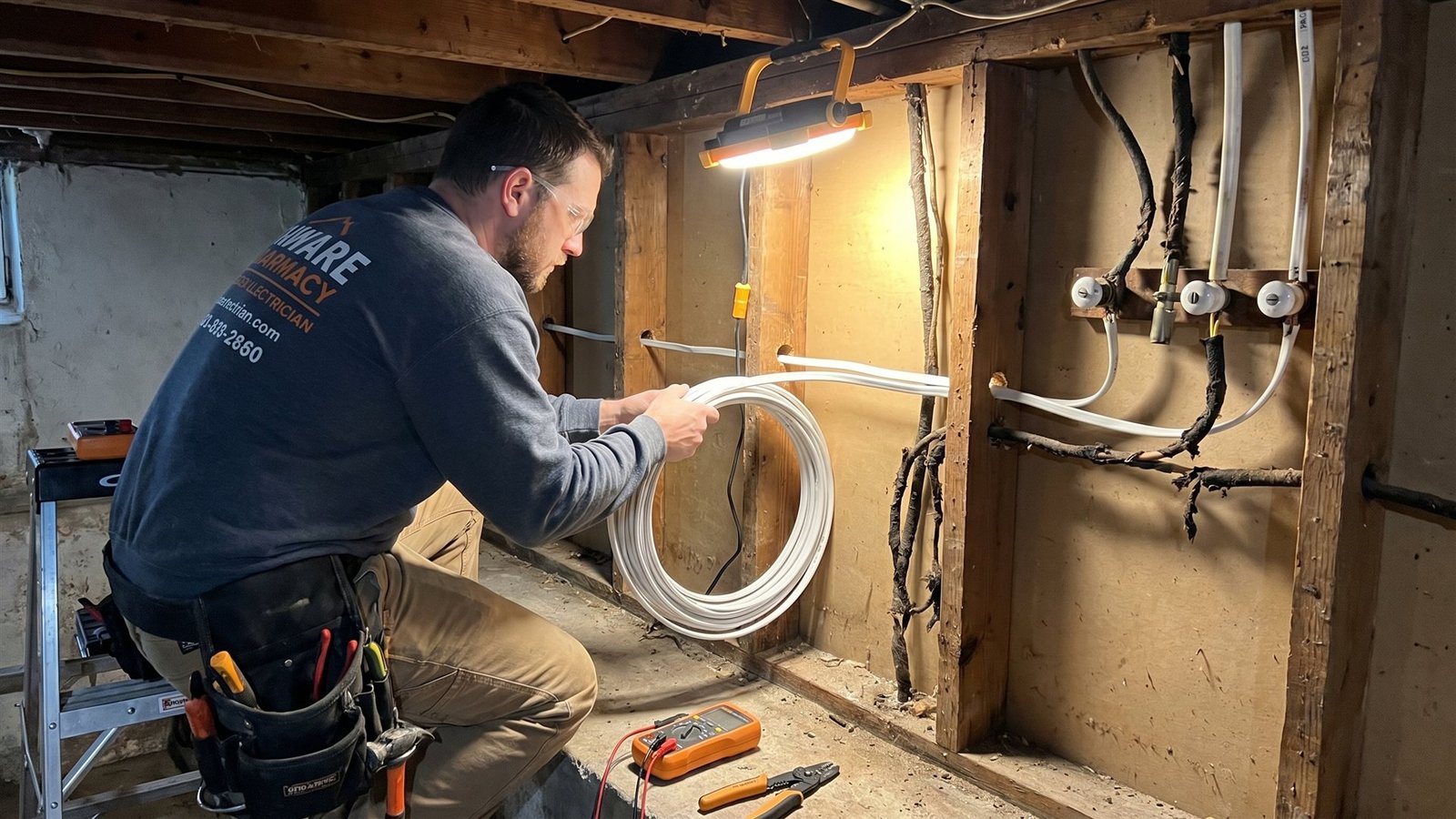
House Rewiring Services — Morris County, NJ
From aluminum branch circuits in 1960s Denville ranches to knob-and-tube in Boonton Victorians, Protocol Services handles every rewiring scenario under NJ License #17230 — permits pulled, inspections passed.
Aluminum Wiring Replacement
Aluminum building wire installed in homes built from 1965 to 1973 expands and contracts at a different rate than the copper terminals on outlets, switches, and fixtures — creating loose connections that arc and overheat over time. The CPSC recognizes aluminum-wired homes as significantly more fire-prone than copper-wired homes. Protocol Services removes all aluminum branch circuits and replaces them with NM-B copper cable throughout. This is the primary rewiring trigger for Denville, Mine Hill, and Rockaway Township homes built during that window.
AFCI & GFCI Protection Throughout
NEC 210.12 requires arc-fault circuit interrupter (AFCI) protection on all 120-volt branch circuits in dwelling units — including bedrooms, living areas, hallways, and kitchens. NEC 210.8 mandates GFCI protection at all wet and damp locations: kitchens, bathrooms, garages, unfinished basements, and exterior outlets. Because older Morris County homes predate both requirements, a full rewire brings the entire home into NEC 2020 compliance. Both AFCI breakers and GFCI devices are included in every Protocol Services rewire.
200-Amp Panel Upgrade Included
Older Dover, Wharton, and Mine Hill homes frequently have 60-amp fused panels or 100-amp service that cannot support a modern home's loads — let alone a Level 2 EV charger, heat pump, or Generac standby generator. NEC Article 230 service entrance requirements govern the upgrade. Because rewiring exposes the entire branch circuit system, most projects include a simultaneous 200-amp panel upgrade — which eliminates a second round of disruption and permits a single inspection sequence for both the rewire and the service upgrade.
FPE Stab-Lok & Zinsco Panel Replacement
Federal Pacific Electric Stab-Lok and Zinsco panels found in many Morris County homes built from 1951 to 1980 have a documented breaker-failure rate — breakers may not trip under fault conditions, which eliminates the primary fire-prevention function of the panel. Both panel types are identified during the Protocol Services pre-rewire assessment and are recommended for replacement as part of the same project scope. Leaving a defective panel in place while rewiring the branch circuits does not resolve the hazard at the service level.
Renovation Rewiring
Many Morris County rewires are triggered by renovation projects — additions, kitchen gut-renovations, basement finishes — that open walls and expose wiring that cannot be left in place. If your renovation scope extends beyond a single room, our renovation electrical service covers the complete scope: K&T and aluminum wiring remediation, NEC Article 220 load calculations, coordination with your general contractor's schedule, and all permit and inspection workflow. A rewire and a renovation project frequently run together under the same permit application.
NJ Permits Pulled, Inspections Scheduled
All house rewiring in New Jersey requires an electrical permit under the NJ DCA Uniform Construction Code. The permit process includes a rough electrical inspection before walls are closed, and a final electrical inspection before the certificate of approval is issued. Protocol Services handles the permit application, coordinates inspection scheduling with the local building department in your Morris County municipality, and is present for both inspection appointments. Permit fees typically range from $100 to $300 depending on municipality and project scope.
Insurance Compliance Documentation
Morris County insurers — responding to NJ DOBI guidance including Order A24-09 (December 2024) on homeowner policy underwriting — are requiring rewiring before renewing policies on homes with aluminum wiring, FPE Stab-Lok panels, or 60-amp service. After a Protocol Services rewire, the final inspection certificate of approval from the local building department provides the primary documentation carriers require. We can also provide a scope letter summarizing the work completed, which satisfies most insurance underwriter review requests when submitting for a new policy or renewal.
What We Find in Morris County's Older Homes
Morris County's building history spans from Victorian-era mill towns to 1970s subdivisions. The wiring hazard in each home depends almost entirely on when it was built — and which materials were code-compliant at that time.
Pre-1940s — Boonton & Dover Victorian Stock
Boonton's 19th-century mill town housing and Dover's Victorian-era residential blocks were wired with knob-and-tube (K&T) — open ceramic insulators and rubber-jacketed conductors with no ground conductor. After 80-plus years, the rubber insulation has hardened and cracked. K&T circuits cannot support modern loads, fail the grounding requirement of NEC 250, and are specifically excluded from home insurance coverage by most NJ carriers. Mountain Lakes lakefront homes from the 1920s and 1930s often fall in this category as well — original wiring from initial construction, never touched.
1940s–1960s — Rockaway & Mine Hill Post-War Ranches
The post-war building boom in Rockaway Township and Mine Hill produced hundreds of ranch and cape-cod homes wired with cloth-wrapped two-wire conductors — no ground wire, minimal circuit count, and 60-amp fused panels that were sized for the appliance loads of the 1950s. Today those panels serve homes with dishwashers, dryers, central air, and EV chargers they were never designed to support. Cloth insulation degrades faster than modern PVC jacket and becomes brittle and flammable over decades of heat cycling. Full rewire and 200-amp panel upgrade is the standard recommendation for homes in this age range.
1965–1973 — Denville & Mine Hill Ranches: Aluminum Branch Circuits
During the mid-1960s copper shortage, aluminum was approved for branch circuit wiring in residential construction. Homes built in this window — including 1960s ranches throughout Denville and Mine Hill — have aluminum branch wiring at outlets, switches, and fixture boxes. The CPSC formally recognized aluminum wiring as a fire hazard in residential applications: aluminum expands and contracts under load at a different rate than the copper terminals it connects to, creating loose connections that arc over time. NJ insurers routinely deny coverage or require rewiring before renewal for homes built in this window. This is Protocol Services' single most common rewiring request in Morris County.
1975–1985 — Wharton & Dover: FPE Stab-Lok & Zinsco Panels
Homes built in Wharton and Dover during the late 1970s and early 1980s may have copper branch wiring that passes inspection — but a Federal Pacific Electric Stab-Lok or Zinsco panel that does not. Both panel types were installed extensively in NJ during this era. The documented hazard: breakers in FPE and Zinsco panels frequently fail to trip under overload or short-circuit conditions. A breaker that does not trip allows fault current to flow until something catches fire. If the branch wiring in a home from this era is copper and in good condition, a panel-only replacement may resolve the safety and insurance issue without a full rewire — Protocol Services evaluates this during the initial assessment.
Whole-House Rewiring Financing — Morris County, NJ
House rewiring is a significant investment that protects your home, your insurance coverage, and your resale value. Protocol Services offers financing options including 0% APR for qualified customers — ask during your estimate appointment. Most Morris County homeowners invest $8,000–$18,000 for a full rewire of a 1,500–2,500 sq ft home; financing spreads that over manageable monthly payments.
View Financing Options Call (908) 878-6479Trusted by Morris County Homeowners
Real reviews from Rockaway, Dover, Wharton, and surrounding communities.
How House Rewiring Works — Morris County, NJ
-
In-Home Electrical Assessment
A Protocol Services licensed electrician inspects your existing wiring type (aluminum, knob-and-tube, cloth-wrapped, or mixed), the current panel brand and amperage, service entrance size, and the permit requirements for your specific Morris County municipality. If a Federal Pacific Electric, Zinsco, or other defective panel is present, it is identified at this stage. You receive a written scope that distinguishes a full rewire from a partial rewire, and specifies whether a 200-amp panel upgrade and service entrance update under NEC Article 230 is part of the project. Many homeowners request this visit as a standalone whole-home electrical safety inspection before committing to a full rewire.
-
Permit Application
Protocol Services files the electrical permit application with your local building department under the NJ DCA Uniform Construction Code. Permit processing typically takes one to two weeks in most Morris County municipalities. Inspection slots are reserved concurrent with permit issuance so the project does not stall waiting for an inspection window. Permit fees range from approximately $100 to $300 depending on municipality and project size.
-
Wiring Removal & Replacement
Existing aluminum branch circuits, knob-and-tube wiring, or cloth-wrapped conductors are removed and replaced with new NM-B copper cable (Romex) sized appropriately for each circuit. Where walls are intact, Protocol Services uses fish-through-wall techniques — routing cable through existing cavities using fish tape and flexible drill bits — to minimize drywall opening and disruption. Attic and basement runs are performed with direct access. Dedicated circuits are added for kitchen appliances, bathrooms, and any high-draw equipment per NEC Article 210 requirements.
-
Panel Upgrade & Protection Devices
If the project includes a 200-amp panel upgrade, the new panel is set and connected to the upgraded service entrance during this phase. AFCI breakers are installed per NEC 210.12 on all 120-volt branch circuits throughout the dwelling — bedrooms, living areas, hallways, kitchens, and dining areas. GFCI protection devices are installed per NEC 210.8 at all kitchen, bathroom, garage, unfinished basement, and exterior circuits. All outlets and switches are upgraded to current-code devices and cover plates.
-
Rough Inspection, Finish Work & Final Inspection
The rough electrical inspection — performed before walls are closed — verifies that all new wiring meets NEC 2020 requirements, circuit routing is correct, and all protection devices are installed. After the rough inspection passes, wall patching and finish work proceeds. Outlets, switches, fixtures, and panel trim are installed. Protocol Services then schedules the final electrical inspection, is present with the inspector, and provides you with the signed certificate of approval issued by your Morris County municipality. This certificate is the document your insurance carrier requires for policy renewal or new policy issuance.
House Rewiring FAQs — Morris County, NJ
How much does house rewiring cost in Morris County, NJ?
Morris County homeowners typically invest $8,000–$18,000 for a full house rewire, depending on home size, age, and scope. A 1,500 sq ft post-war ranch in Mine Hill that needs only branch circuit replacement falls toward the lower end. A 2,500 sq ft Boonton Victorian with knob-and-tube, a 60-amp panel replacement, and significant drywall work falls toward the upper end. Projects that include a simultaneous 200-amp panel upgrade add $1,500–$3,500 to the base rewiring cost but avoid a second round of permits, inspection, and disruption. Protocol Services provides a written estimate at the in-home assessment — call (908) 878-6479 to schedule.
How much does it cost to rewire a 2,000 sq ft house?
For a 2,000 sq ft home in Morris County, the rewiring investment typically falls in the $10,000–$15,000 range, using the $6–$10 per square foot industry benchmark for NJ electrical rewiring. The actual figure depends on wiring type (aluminum vs. knob-and-tube vs. cloth-wrapped), wall construction, attic and basement access, and whether a panel upgrade is included. Homes with plaster walls — common in Boonton and Mountain Lakes — require more labor for access than drywall construction, which pushes the project toward the higher end of the range.
How much do electricians charge to wire a whole house?
NJ electricians typically charge $6–$10 per square foot for a full house rewire, which translates to $7,800–$13,000 for a 1,300 sq ft home and $12,000–$20,000 for a 2,000 sq ft home on the higher end. These figures are for rewiring existing occupied homes — new construction wiring costs less because there are no existing materials to remove and walls are open. The per-square-foot metric is a starting benchmark; the final estimate reflects the specific scope, panel condition, and access conditions in your home.
Is aluminum wiring dangerous in older NJ homes?
Yes — aluminum branch wiring installed in homes built from 1965 to 1973 is a CPSC-recognized fire hazard. Aluminum expands and contracts under electrical load at a different rate than the copper terminals on outlets and switches. Over decades, this creates loose connections that arc, overheat, and can ignite surrounding materials. The CPSC found that homes with aluminum wiring are significantly more likely to have at least one wire connection reach fire-hazard conditions than homes with copper wiring. Most Morris County insurance carriers now require remediation for homes built in this window before issuing or renewing a homeowners policy.
Do I need a permit for house rewiring in Morris County, NJ?
Yes — any house rewiring in New Jersey requires an electrical permit filed with the local building department under the NJ DCA Uniform Construction Code. The permit triggers a rough electrical inspection before walls close and a final inspection before the certificate of approval is issued. Permit fees are typically $100–$300 depending on the municipality. Work performed without a permit is not inspected, does not receive a certificate of approval, and creates a disclosure liability at resale. Protocol Services files all permit applications and is present for both inspections under NJ License #17230.
Can a homeowner do their own electrical work in NJ?
In New Jersey, a homeowner may perform electrical work on their own owner-occupied single-family home without a contractor's license. However, all work still requires a permit, a licensed inspector must approve both rough and final inspections, and the homeowner must be present and available to the inspector throughout. For house rewiring specifically — which involves permit coordination, rough inspections before walls close, and final inspections — most homeowners find the scheduling and technical complexity significant. Any work that is not permitted or does not pass inspection creates an insurance and resale liability. Licensed contractor work under NJ #17230 carries workmanship accountability that owner-performed work does not.
How long does house rewiring take in Morris County?
A full rewire of an average Morris County home takes three to seven business days for the electrical work itself. Homes with open attic and basement access tend to fall toward the shorter end; homes with plaster walls, finished basements, or complex layouts require more time. The permit and inspection sequence adds one to two weeks for permit processing before work begins, plus an inspection scheduling window at both rough and final stages. Total elapsed time from estimate to final certificate is typically three to five weeks, though the disruption to the home is concentrated in the three-to-seven-day active wiring period. Protocol Services uses fish-through-wall techniques wherever possible to minimize drywall opening.
Is partial rewiring enough or do I need a full rewire?
A partial rewire — covering only the kitchen, bathrooms, or specific circuits — is appropriate when wiring in the rest of the home is copper, in good condition, and already grounded. A full rewire is the correct scope when: (1) aluminum branch wiring runs throughout the home, (2) knob-and-tube is present in living areas or bedrooms, (3) the home predates 1960 and has a 60-amp panel, or (4) insurance underwriting requires whole-home remediation. In practice, most Morris County homes that have triggered an insurance denial have aluminum or K&T wiring throughout — making a partial rewire insufficient to satisfy the carrier's requirement. The Protocol Services assessment identifies which scenario applies before any work is quoted.
Does insurance cover house rewiring in NJ?
Homeowners insurance rarely covers the cost of rewiring itself. Insurance is designed to cover sudden, accidental losses — not the correction of a known hazard. If a fire caused by faulty wiring results in damage, the insurance claim covers the damage (subject to policy terms), but the underlying wiring defect is still a pre-existing condition. What insurance refusal does trigger is the need to rewire before coverage is reinstated. Knob-and-tube wiring, Federal Pacific Stab-Lok panels, and ungrounded aluminum wiring are the three most common reasons NJ carriers deny or cancel coverage. An inspection report documenting the hazard — combined with the Protocol Services estimate — is what most insurers require to begin the underwriting process after remediation is complete.
Does house rewiring increase home value in NJ?
Yes — in practical terms, rewiring removes the barriers that prevent a home from being insured, financed, or sold at market value. A Morris County home with aluminum wiring or a Federal Pacific panel that cannot obtain insurance coverage is essentially unsellable through conventional financing, because lenders require proof of insurance at closing. After rewiring and receiving the certificate of approval, that barrier is gone. Buyers pay market price for homes they can insure and finance; they discount homes they cannot. Rewiring also eliminates the disclosure obligation that applies to known hazards in NJ real estate transactions, which further improves the seller's position at the negotiating table.
Protocol Services - Electric & Air
350 US-46 Suite 217Rockaway, NJ 07866 (908) 878-6479
24/7 Emergency Electrical Service
Licensed · Bonded · Insured
NJ Electrical License #17230
QMerit Certified EV Installer · Generac Dealer
Carrier Dealer · Rheem Dealer
Serving Morris County Since 2011
About Morris County, NJ
Morris County stretches along Route 46, I-80, and Routes 202/206 — corridors lined with mid-century colonials, split-levels, and Cape Cods built primarily between 1955 and 1985. Towns like Dover, Wharton, Mine Hill, and Rockaway Borough carry high concentrations of older Federal Pacific Electric and Zinsco panels that were installed during that era and are now well past service life. Lakefront neighborhoods — White Meadow Lake, Lake Telemark, Indian Lake, and Hibernia — see a mix of seasonal cottages and year-round homes, many with outdated 100-amp service that can't support modern loads. Affluent communities like Denville, Randolph, and Parsippany-Troy Hills drive strong demand for 200-amp upgrades to support Level 2 EV chargers, Generac standby generators, and heat pump systems from Carrier, Mitsubishi, and Fujitsu. Landmarks like Jockey Hollow National Historical Park, the Great Swamp National Wildlife Refuge, and Lake Hopatcong — NJ's largest lake — anchor a county where older infrastructure and modern energy demands meet head-on.
Morris County Communities We Serve
Outside this list? Call (908) 878-6479 — we serve all of Northern NJ.
Free Rewiring Estimate for Morris County NJ Homes
Protocol Services - Electric & Air — NJ License #17230 — Fully Licensed, Bonded & Insured — Serving older Morris County homes since 2011. We replace aluminum wiring, knob-and-tube, and cloth-wrapped circuits with copper NM-B cable to NEC 2020 standards. Permits pulled. Inspections passed. Insurance documentation provided.
Schedule Your Estimate Call (908) 878-6479