
Tenant Improvement Electrician for Morris County NJ Buildouts
Protocol Services LLC partners with general contractors, property managers, and commercial tenants to deliver code-compliant electrical buildouts across Morris County. From panel and feeder work to low-voltage rough-in and Certificate of Occupancy inspections, we manage every phase of your commercial fit-out. NJ Electrical License #17230 — serving commercial clients since 2011.
NJ Electrical License #17230. Off-hours and phased scheduling available to keep your build-out on schedule. 100% satisfaction guarantee on every job.
Commercial Electrical Buildouts Built Around Your Schedule and Scope
Tenant improvement electrical work is purpose-built construction — converting raw or previously occupied leased space into a functional commercial environment. For general contractors managing multi-trade buildouts and property managers responsible for getting tenants into Certificates of Occupancy, the electrical subcontractor sets the pace. Rough-in delays cascade into inspection backlogs, CO delays, and lease commencement disputes. Protocol Services coordinates from permit application through final inspection so your buildout timeline holds.
We work directly with GCs, tenant representatives, and property managers across Morris County — from single-suite office fit-outs in Parsippany to multi-floor commercial renovations in Dover and Rockaway. Our scope includes new panel installations sized for three-phase commercial loads, branch circuit rough-in to NEC 2020 standards (NJ adopted September 2022 per >NJAC 5:23-3.16), low-voltage rough-in coordinated with your cabling contractor, and commercial lighting systems compliant with ASHRAE 90.1 lighting power density requirements.
If your tenant carries a Tenant Improvement Allowance from the landlord, we work within that defined scope and provide the documentation your GC and property manager need to close out the project cleanly. For a broader overview of our commercial electrical services in Morris County, including three-phase upgrades, switchboard replacement, and commercial generator installations, visit our commercial electrical page.
- Three-phase panel installation and feeder sizing (NEC Article 215)
- Branch circuit rough-in in EMT conduit and MC cable
- Low-voltage rough-in (Cat6 / structured cabling coordination)
- Emergency lighting and exit sign installation (NEC Article 700)
- Commercial lighting systems (NEC Article 410 / ASHRAE 90.1 LPD compliance)
- ADA-compliant device placement (15"–48" AFF receptacles; 48" max switches)
- Commercial permit application and CO inspection management (NJAC 5:23)
Visit our Morris County electrical contractor hub for our full range of residential and commercial electrical services.
What Protocol Handles on Your Commercial Tenant Buildout
Panel and Feeder Work
Commercial tenant spaces almost always require a dedicated panelboard fed from the building's main distribution. We size feeders to 125% of continuous load per NEC Article 215, install panelboards to NEC Article 408, and produce a complete panel schedule for permit submission and landlord sign-off. Three-phase distribution is standard for most B and M occupancies; we confirm load capacity before rough-in begins so your tenant is not constrained by undersized infrastructure.
Branch Circuit Rough-In and Raceway
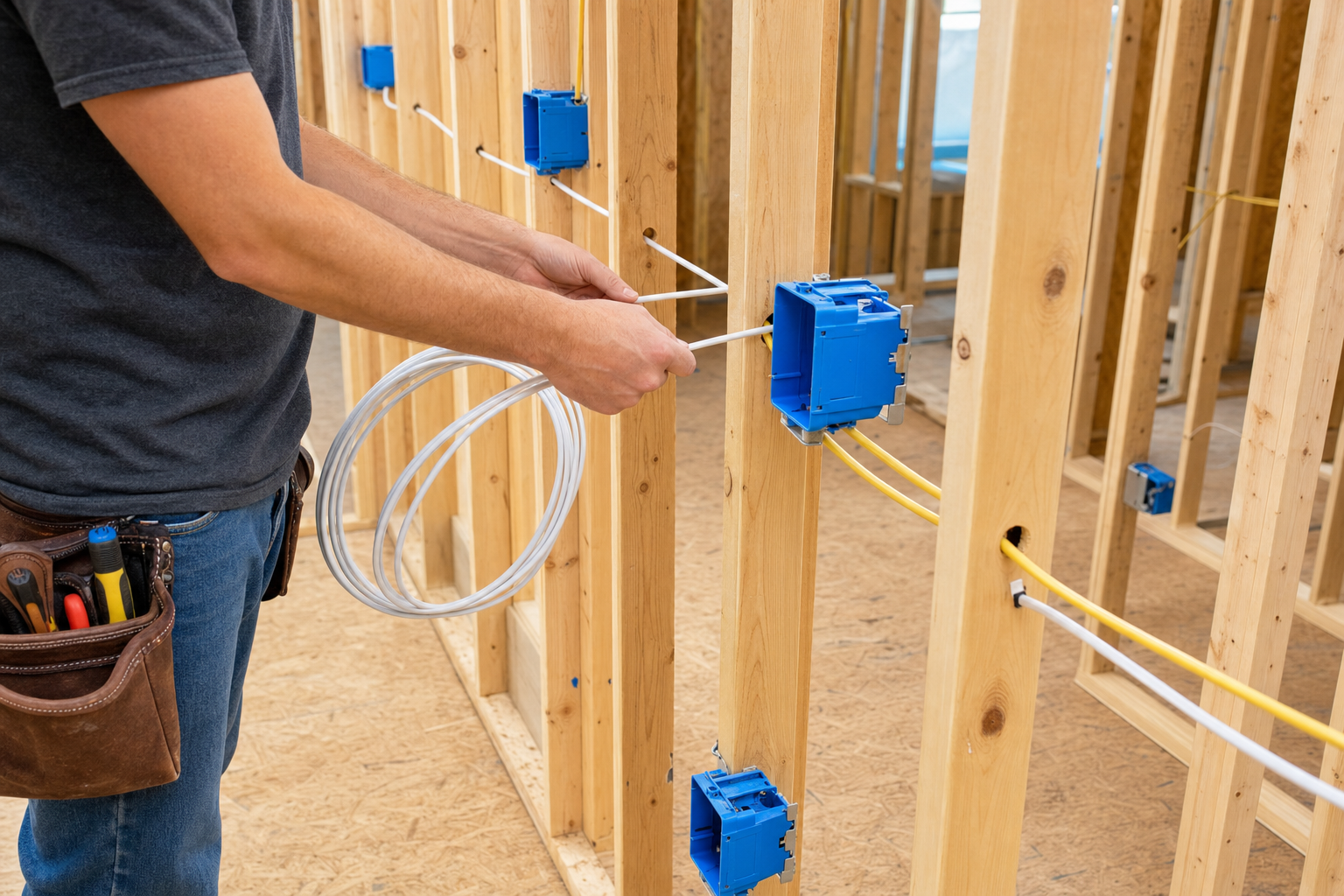
Commercial rough-in is not residential work dressed up in a hard hat. EMT conduit (NEC Article 358) is the standard raceway for exposed commercial installations; MC cable (NEC Article 330) is used in concealed locations and above accessible ceilings. We pull branch circuits to code-minimum spacing and layout, then document the installation for rough-in inspection before any framing closes up.
Emergency Lighting and Exit Signs
Every commercial occupancy requires emergency lighting and illuminated exit signs under NFPA 101 Life Safety Code. NEC Article 700 governs the electrical supply to emergency systems — including the 10-second transfer requirement for battery backup or generator-fed circuits. We install, test, and document the emergency lighting system as part of the rough-in phase, not as a last-day add-on that holds up your CO.
Low-Voltage Rough-In Coordination
Modern commercial office and retail buildouts require data, voice, and AV rough-in to happen in sequence with the electrical rough-in — often within the same sleeves, pathways, and above-ceiling routes. We coordinate with your structured cabling contractor so conduit sleeves, j-hook runs, and pull string are placed during the electrical rough-in window. This eliminates the schedule collision that happens when trades work in the same ceiling space without coordination.
Commercial Permit and CO Management
Commercial electrical work in New Jersey requires a permit under NJAC 5:23 before any work begins. We handle permit application, produce the load letter and panel schedule documentation required by the AHJ, coordinate rough-in and final inspections, and provide you and your GC with inspection result documentation at every phase. Your CO requires all electrical subcodes to pass — we track that internally so it does not become your problem to chase.
ADA Compliance and Occupancy Classification
Electrical device placement is not optional under ADA — receptacles must be mounted between 15" and 48" AFF; switches at 48" maximum. We apply the correct requirements based on occupancy classification: B (office), M (retail), or A-2 (restaurant) each carry different electrical and life-safety requirements. Getting this wrong at rough-in means rework during trim, which costs time no GC has in a buildout schedule.
Why General Contractors and Property Managers Choose Protocol for Commercial Work
- NJ Licensed and Commercially Experienced — NJ Electrical License #17230. Operating since 2011 with a track record of commercial tenant buildouts across Morris County under NJ UCC and NJAC 5:23 permitting.
- Documentation That Moves the Job Forward — We produce the panel schedule, load letter, and inspection documentation your GC and landlord require. No chasing the electrical sub for paperwork two days before inspection.
- Three-Phase Load Planning from Day One — Commercial buildouts fail at trim when panel capacity was not verified at design. We confirm three-phase load capacity, size feeders correctly under NEC Article 215, and document it before rough-in begins.
- Permit Application Handled In-House — We apply for the commercial electrical permit under NJAC 5:23, coordinate with the Morris County AHJ, and manage all inspection scheduling. Your GC stays on scope; we own the permit track.
- Emergency Lighting and Life-Safety Built Into Schedule — NEC Article 700 and NFPA 101 requirements are not afterthoughts. Emergency lighting, exit sign circuits, and 10-second transfer compliance are scheduled and inspected as part of the rough-in phase.
- Low-Voltage and Trade Coordination — We flag sleeve locations, conduit pathways, and ceiling congestion points before the drywall schedule starts, eliminating the trade conflicts that cause inspection failures.
- CO Deadline Accountability — Certificate of Occupancy dates are tied to lease commencement. We track our inspection milestones against your CO target and surface delays early — not the day before.
How Commercial Electrical Buildouts Work with Protocol
From scope review to Certificate of Occupancy — here's exactly what Protocol does.
-
Initial Scope Review and Load Analysis
We review the architectural drawings, confirm occupancy classification (B, M, A-2, or other), and assess existing panel capacity. Three-phase load requirements are calculated before permit application — not discovered at rough-in. If the tenant carries a Tenant Improvement Allowance, we align our scope to that budget ceiling and provide itemized documentation.
-
Permit Application
We submit the commercial electrical permit application to the Morris County AHJ under NJAC 5:23, including the panel schedule and load letter. No electrical work begins before permit issuance. Your GC receives a permit confirmation copy.
-
Rough-In Wiring and Low-Voltage Coordination
EMT conduit and MC cable rough-in runs in coordination with framing. Low-voltage conduit sleeves and pathway coordination happen concurrently with your cabling contractor. Emergency lighting circuits, panel feeder, and all branch circuit rough-in are installed and ready for rough-in inspection before framing closes.
-
Rough-In Inspection
We schedule the rough-in inspection with the AHJ, accompany the inspector, and document results. Any correction notices are resolved within the same schedule window — we do not hand you a punch list and disappear.
-
Trim-Out, Final Inspection, and CO
Devices, fixtures, panelboard trim, emergency lighting fixtures, and exit signs are installed after finish work. We schedule final electrical inspection, confirm all NEC 2020 and NFPA 101 requirements are met, and provide your GC and property manager with signed inspection documentation to close the electrical subcode for CO issuance.
Frequently Asked Questions About Commercial Tenant Improvement Electrical Work
What is a tenant improvement?
A tenant improvement (TI) is construction or fit-out work performed to customize a leased commercial space for a specific tenant's use. Electrical work in a tenant improvement typically includes new panel circuits, lighting, data rough-in, emergency systems, and ADA-compliant device placement. The scope is defined in the lease or a separate work letter between landlord and tenant, and all work must be permitted and inspected under NJAC 5:23 in New Jersey before a Certificate of Occupancy is issued.
What is an example of a tenant improvement?
A common example is a general contractor converting a vacant multi-tenant office suite in a building like Morris Corporate Center in Parsippany into a finished corporate office. Electrical work would include installing a dedicated panelboard fed from the building's main distribution system, pulling branch circuits to NEC 2020 standards, installing commercial lighting to ASHRAE 90.1 lighting power density limits, rough-in for Cat6 data drops, and installing emergency lighting and exit signs to NFPA 101 requirements — all before a CO inspection.
Is electrical wiring a leasehold improvement?
Yes. Electrical wiring installed during a commercial buildout is typically classified as a leasehold improvement (also called a tenant improvement) because it is affixed to the building and customizes the space for the tenant's use. This classification matters for accounting purposes — leasehold improvements are amortized over the lease term or useful life under GAAP. The landlord usually retains ownership of fixed electrical infrastructure (panels, feeders) at lease end; negotiated terms govern tenant-installed fixtures and devices.
What is a typical tenant improvement allowance?
A Tenant Improvement Allowance (TIA) is a per-square-foot budget provided by the landlord to fund buildout work. Allowances in Morris County commercial markets vary based on market conditions, lease term length, and building class — Class A office space typically carries higher allowances than flex or light industrial. The TIA is applied against the total buildout cost; the tenant funds any overrun. Protocol works within the TIA scope defined in your work letter and provides the documentation your property manager and GC need to reconcile the allowance draw.
Do tenants or landlords pay for electrical work in a commercial buildout?
It depends on what is in the lease. The landlord typically funds work up to the agreed Tenant Improvement Allowance. Work beyond that amount, or work the tenant requests outside the landlord's scope, is typically the tenant's responsibility. In some buildouts, the landlord contracts directly with the electrical contractor; in others, the GC manages all trades and reconciles against the TIA. Protocol works with both models — directly with property managers on landlord-managed buildouts and as a subcontractor to GCs on tenant-managed buildouts.
What permits are required for commercial tenant electrical work in New Jersey?
All commercial electrical work in New Jersey requires a permit under NJAC 5:23 before work begins, per the NJ Uniform Construction Code (NJ UCC). The electrical subcontractor (not the tenant or property manager) pulls the permit and is responsible for scheduling rough-in and final inspections with the Authority Having Jurisdiction (AHJ). A Certificate of Occupancy cannot be issued until all subcodes — including electrical — pass final inspection. Protocol handles permit application, inspection scheduling, and documentation as part of every commercial buildout.
How long does commercial electrical rough-in take on a tenant buildout?
Rough-in duration depends on the suite size, occupancy type, and panel scope. A single-floor office suite of 3,000–5,000 SF typically requires 3–5 business days for electrical rough-in if the framing schedule is on track. Multi-floor or mixed-occupancy buildouts run longer. The critical path constraint is usually framing readiness and permit issuance timing — delays in either push the rough-in inspection window and can compress the overall CO timeline. Protocol confirms scope and inspection milestones with your GC during the initial scope review.
Can Protocol coordinate with other trades during a commercial buildout?
Yes — trade coordination is standard practice on commercial tenant buildouts, and we treat it as part of our scope. We coordinate low-voltage rough-in pathways with your structured cabling contractor, confirm ceiling heights and above-ceiling routes with mechanical and plumbing, and flag conduit conflicts before framing closes. We attend pre-construction meetings and OAC calls when your GC requires it. The goal is that the rough-in inspection passes clean on the first attempt — trade conflicts are the most common reason it does not.
Trusted by Morris County Homeowners
Real reviews from Rockaway, Dover, Wharton, and surrounding communities.
Commercial Electrical Buildout Service — Morris County, NJ
NJ Licensed electrical contractor (License #17230) serving general contractors and property managers across Morris County for commercial tenant improvement buildouts since 2011.
Protocol Services - Electric & Air
350 US-46 Suite 217Rockaway, NJ 07866 (908) 878-6479
24/7 Emergency Electrical Service
Licensed · Bonded · Insured
NJ Electrical License #17230
QMerit Certified EV Installer · Generac Dealer
Carrier Dealer · Rheem Dealer
Serving Morris County Since 2011
About Morris County, NJ
Morris County stretches along Route 46, I-80, and Routes 202/206 — corridors lined with mid-century colonials, split-levels, and Cape Cods built primarily between 1955 and 1985. Towns like Dover, Wharton, Mine Hill, and Rockaway Borough carry high concentrations of older Federal Pacific Electric and Zinsco panels that were installed during that era and are now well past service life. Lakefront neighborhoods — White Meadow Lake, Lake Telemark, Indian Lake, and Hibernia — see a mix of seasonal cottages and year-round homes, many with outdated 100-amp service that can't support modern loads. The Route 46 commercial corridor and established business campuses like Morris Corporate Center — a 182-acre Class A office complex in Parsippany-Troy Hills — generate consistent demand for tenant improvement and buildout electrical work, while the International Trade Center at Mount Olive continues to attract new commercial tenants requiring fit-out from the ground up. Denville, Randolph, and Parsippany-Troy Hills also see residential demand for panel upgrades, EV charger circuits, and Generac standby systems. Landmarks like Jockey Hollow National Historical Park, the Great Swamp National Wildlife Refuge, and Lake Hopatcong — NJ's largest lake — anchor a county where older infrastructure and modern energy demands meet head-on.
Morris County Communities We Serve
Outside this list? Call (908) 878-6479 — we serve all of Northern NJ.
Get a Commercial Electrical Buildout Quote in Morris County
General contractors and property managers across Morris County rely on Protocol Services for tenant improvement electrical work that stays on schedule, passes inspection the first time, and produces the documentation your project close-out requires. Protocol Services LLC holds NJ Electrical License #17230 and has been executing commercial buildouts in Morris County since 2011 — from permit application through Certificate of Occupancy. Call (908) 878-6479 or submit your buildout scope online and we will respond within one business day.
Request a Buildout Quote Call (908) 878-6479