
Commercial Electrician Morris County NJ — Full-Service Commercial Electrical Contractor
Protocol Services - Electric & Air provides licensed commercial electrical services across Morris County — three-phase power, tenant improvement wiring, commercial panel upgrades, and EV charging infrastructure for offices, retail, and light industrial properties. NJ License #17230.
NJ Electrical License #17230. Off-hours and phased scheduling available to keep your business running. 100% satisfaction guarantee on every job.
Commercial Electrical Services for Morris County Businesses
Protocol Services - Electric & Air serves commercial clients throughout Morris County with a full range of electrical contracting services: three-phase service upgrades, commercial panel and switchboard replacement, tenant improvement electrical wiring, commercial generator installations with transfer switches, commercial lighting and LED retrofit, commercial EV charging infrastructure, and emergency egress lighting under NEC Article 700 and NFPA 101. Whether your business operates from a Parsippany office park, a Route 46 retail strip, or a Dover light-industrial facility, Protocol provides the licensed commercial electrical work your building needs to stay safe, code-compliant, and operationally ready.
Commercial electrical work is fundamentally different from residential work — and the difference starts before a single wire is run. Every commercial project begins with an NEC Article 220 load calculation to determine true service demand, factoring in demand factors for lighting, HVAC, motor loads, and specialty equipment. Large service upgrades require formal coordination with JCP&L for transformer sizing, metering, and service energization — a process that can run two to four weeks for services 400 amps and above. When a building's existing panelboard cannot support expanded tenant loads or new equipment, a commercial panelboard upgrade is the foundation of any larger electrical project. Three-phase power (208V for small commercial, 480V for large commercial and light industrial) requires different equipment, different wiring methods, and different balancing strategies than the single-phase 120/240V power in a home. These aren't details a residential-only contractor can improvise on the fly. Protocol's commercial experience means your load calculation, utility coordination, and panelboard sizing are done right the first time.
Protocol also serves as a single commercial contractor for both electrical and HVAC needs — a significant advantage for facility managers and general contractors managing commercial build-outs and tenant improvements. We also provide new construction electrical work for ground-up commercial and residential builds throughout Morris County, from permit pull through Certificate of Occupancy. Coordinating two separate trade contractors for mechanical and electrical rough-in is a scheduling risk on every project; Protocol eliminates that risk with one point of contact, one contract, and one crew that understands how commercial electrical systems and HVAC systems interact. NJ License #17230 covers all commercial electrical work Protocol performs throughout Morris County and surrounding counties. For residential electrical services, visit our Morris County electrical services hub.
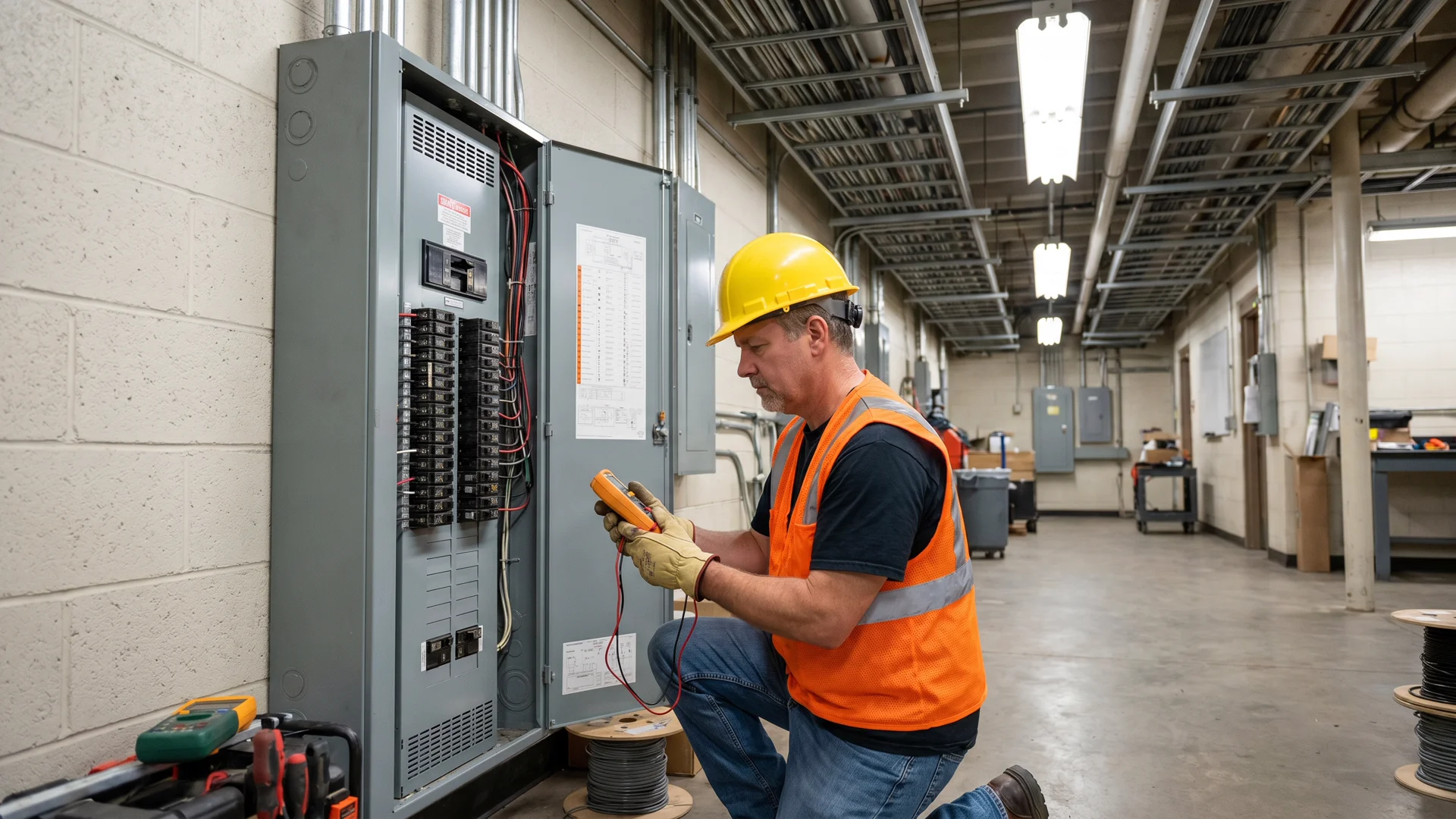
What Protocol Delivers for Morris County Commercial Clients
Three-Phase Power Installation
Most commercial and light-industrial equipment runs on three-phase power — HVAC compressors, CNC machines, commercial refrigeration, elevators, and large motor loads all require it. Protocol designs and installs 208V three-phase service for small commercial buildings and 480V three-phase service for larger commercial and light-industrial facilities throughout Morris County. Every installation begins with an NEC Article 220 load calculation to size the service accurately and coordinate with JCP&L on transformer capacity and utility interconnect requirements. Businesses in Dover and Wharton operating out of older industrial stock often discover their existing service is undersized for modern three-phase equipment — Protocol's assessment and upgrade process addresses that head-on.
Tenant Improvement Wiring
When a commercial tenant moves into a new space — or an existing tenant renovates — the electrical rough-in has to be completed before finishes go in. Protocol installs new branch circuits, dedicated circuits for equipment, commercial-grade receptacles, lighting circuits, and HVAC electrical connections for tenant improvement (TI) projects at office, retail, and restaurant spaces throughout Parsippany, Rockaway, and Dover commercial corridors. TI work is coordinated directly with general contractors and building owners to hit construction schedules; Protocol pulls all required permits under the NJ DCA Uniform Construction Code electrical subcode and schedules inspections through project completion and certificate of occupancy sign-off.
Commercial Panel & Switchboard Upgrades
An undersized or aging commercial panelboard is a capacity and safety problem — it limits what your facility can run and increases the risk of nuisance tripping, overloading, and arc faults. Protocol installs Square D I-Line commercial panelboards and switchboards, Eaton Pow-R-Line distribution equipment, and Siemens SENTRON switchboards for Morris County commercial facilities. Equipment is sized under NEC Article 408, which governs commercial panelboards and switchgear, and Article 230, which covers service entrance conductors and main disconnects. Capacity is calculated for current loads with headroom for future expansion — a critical consideration for Parsippany office parks and Route 46 commercial tenants who frequently add equipment over their lease term.
Commercial EV Charging Infrastructure
Commercial EV charging is no longer optional for Morris County office parks, retail centers, and mixed-use properties — tenants and employees expect it, and NJ's EV adoption rate continues to rise. Protocol is QMerit Certified for commercial EV charging installation, which means manufacturers, fleet operators, and incentive programs recognize Protocol as a qualified installer. Protocol installs Level 2 commercial EVSE (240V, typically 30–80 amps per port) for office and retail parking lots and lays the electrical infrastructure for DC fast charger (DCFC) installations requiring 480V three-phase service. Commercial EVSE installations may qualify for the federal 30C tax credit (up to 30% of equipment and installation costs) — Protocol's team provides the documentation and permit records your tax professional needs to support the credit claim.
Emergency Egress Lighting (NEC Article 700)
Every commercial occupancy in NJ is required to maintain illuminated egress paths under NFPA 101 (Life Safety Code) and NEC Article 700, which covers emergency electrical systems. Protocol installs LED exit signs with battery backup, 90-minute emergency egress luminaires, and central battery systems for larger commercial occupancies. These systems must be tested, labeled, and documented — and they are inspected by the NJ DCA fire subcode official during certificate of occupancy and annual fire inspections. Protocol handles installation, testing documentation, and fire subcode coordination so your CO process doesn't get held up over emergency lighting deficiencies. This is a line item every Morris County commercial TI project needs, and one no responsible electrical contractor skips.
JCP&L Service Coordination
Commercial service upgrades above 200 amps — and virtually all three-phase service installations — require formal coordination with JCP&L (Jersey Central Power & Light), the investor-owned utility serving Morris County. This process includes a utility application, transformer sizing review, metering equipment specification, and scheduled service energization. Protocol manages the entire JCP&L coordination process for commercial clients: utility applications, load data submission, and scheduling of utility crews for the service cutover. For large services (400A and above), plan for two to four weeks from permit approval to energization — Protocol sets realistic timelines upfront so your project schedule reflects actual utility lead times, not wishful thinking.
Commercial Electrical Services Protocol Provides in Morris County
Protocol serves commercial clients across the full scope of electrical contracting — from routine service calls at Parsippany office parks to large-scale three-phase service installations for Dover and Wharton light-industrial facilities. Core commercial electrical services include:
- Three-Phase Service Upgrades — 208V and 480V three-phase service installation and upgrade; Article 220 load calculation; JCP&L utility coordination
- Commercial Panel Replacement — Square D I-Line, Eaton Pow-R-Line, and Siemens SENTRON panelboards and switchboards; NEC Article 408-compliant sizing; capacity planning for future loads
- Tenant Improvement (TI) Wiring — Branch circuits, dedicated equipment circuits, commercial receptacles, lighting, and HVAC electrical connections for office, retail, and restaurant TI projects
- Commercial EV Charging Stations — QMerit Certified Level 2 and DC fast charger infrastructure; parking lot conduit and wiring; 30C tax credit documentation support
- Generator Installation & Transfer Switch (Commercial) — Generac commercial standby generators; automatic transfer switches (ATS); critical load panels for data, HVAC, and life safety circuits
- Emergency Egress Lighting — NEC Article 700 emergency systems; LED exit signs; 90-minute battery backup egress luminaires; NFPA 101-compliant installation for certificates of occupancy
- Commercial Lighting Retrofits — LED retrofit of commercial office, warehouse, and exterior lighting; occupancy sensor integration; NJ Clean Energy Program compatibility
- Electrical Load Calculations (NEC Article 220) — Service demand analysis, demand factor application, motor load assessment, and load scheduling for commercial facilities of all sizes
- JCP&L Utility Coordination — Utility applications, transformer sizing, metering specification, and service energization scheduling for large commercial service upgrades
- Commercial Permit & Inspection Management — Permit filing under NJ DCA Uniform Construction Code; electrical subcode and fire subcode scheduling; final inspection coordination through CO issuance
- Certificate of Occupancy Electrical Sign-Off — Final electrical inspection, punch-list resolution, and documentation package for building owner and general contractor records
- Commercial HVAC Electrical Coordination — Electrical rough-in for commercial HVAC systems; dedicated circuits for rooftop units, split systems, and commercial refrigeration; one contractor for electrical and mechanical on Morris County commercial fit-outs
Get a Commercial Electrical Quote for Your Morris County Project
Protocol provides detailed scope, timeline, and firm pricing for commercial electrical projects of all sizes — from a single-tenant TI wiring job in a Rockaway retail strip to a full three-phase service upgrade and switchboard replacement for a Parsippany office building. No vague ranges, no surprises at invoice. Every commercial quote includes the Article 220 load calculation and permit cost estimate so your project budget is complete from day one.
Trusted by Morris County Homeowners
Real reviews from Rockaway, Dover, Wharton, and surrounding communities.
How Protocol Manages a Commercial Electrical Project in Morris County
Commercial electrical projects involve permitting, utility coordination, and multi-trade scheduling that don't exist on residential jobs. Here is how Protocol manages that complexity from first call to certificate of occupancy.
-
Commercial Electrical Assessment
Protocol's commercial electricians visit your facility to evaluate the existing electrical service, panel condition, three-phase availability, and specific project requirements. For service upgrades, Protocol performs a full NEC Article 220 load calculation — measuring actual demand for lighting (Article 220.12 applies the unit-load method for commercial occupancies), HVAC, motor loads, and receptacle circuits, then applies the appropriate demand factors to determine the minimum service size required. The output is a written scope and specification document used for permitting, utility coordination, and project pricing.
-
Permit Application & JCP&L Coordination
Protocol files the commercial electrical permit with the appropriate Morris County municipality under the NJ DCA Uniform Construction Code, electrical subcode. For projects involving service upgrades or new three-phase service, Protocol simultaneously initiates the JCP&L utility coordination process — submitting load data, specifying metering equipment, and confirming transformer capacity. JCP&L coordination for services 400 amps and above typically runs two to four weeks from application to utility approval; Protocol sets your project schedule around actual utility lead times, not estimates that slip.
-
Service & Panel Installation
Once permits are approved and utility coordination is confirmed, Protocol installs the new service entrance per NEC Article 230 — service conductors, meter socket, main disconnect, and service entrance equipment meeting the NJ DCA electrical subcode requirements. Commercial panelboards and switchboards (Square D I-Line, Eaton Pow-R-Line, or Siemens SENTRON per specification) are installed per NEC Article 408, with branch circuit directories, proper labeling, and grounding systems. For occupied commercial buildings, Protocol develops a phased work schedule — staging work during off-hours, nights, or weekends to minimize operational disruption to your business and your tenants.
-
Branch Circuit & Specialty Work
With the service and distribution equipment in place, Protocol completes the project-specific scope: tenant improvement branch circuits and dedicated equipment circuits; commercial EV charging infrastructure (conduit, wiring, panel space, and EVSE mounting); emergency egress lighting under NEC Article 700 and NFPA 101; commercial generator interconnect and automatic transfer switch installation; commercial lighting retrofits; and HVAC electrical connections where Protocol is handling both trades. All work is completed to NEC 2020 standards as adopted by NJ, with all materials and installation methods documented for the electrical subcode inspection.
-
Commercial Inspection & CO Sign-Off
Protocol schedules and manages the electrical subcode inspection with the local municipality's construction official. For projects with emergency egress lighting or fire alarm integration, Protocol also coordinates the fire subcode inspection. After all inspections pass, Protocol provides the building owner and general contractor with a complete documentation package — inspection approvals, permit closure records, equipment cut sheets, and test records for emergency systems. The certificate of occupancy is issued once all subcodes sign off; Protocol's documentation makes that process straightforward rather than a source of last-minute delays.
Commercial Electrical FAQs — Morris County NJ
Questions commercial clients in Morris County ask most often about commercial electrical work. Answers reflect general industry standards and NJ-specific requirements; contact Protocol for project-specific guidance.
How much do commercial electricians charge in Morris County NJ?
Commercial electrician labor rates in Morris County NJ typically run $100 to $200 per hour, depending on project complexity, crew size, and licensing requirements. Hourly rate is rarely how commercial projects are priced, however — most commercial electrical work is quoted as a fixed-scope contract after the electrician performs a load calculation and site assessment. A single-tenant TI wiring job in a small Rockaway retail space might run $5,000 to $15,000. A full three-phase service upgrade and switchboard replacement for a Parsippany office building typically runs $20,000 to $75,000+, depending on service size, equipment specification, and JCP&L coordination complexity. Protocol provides detailed written quotes after a site visit — call (908) 878-6479 to schedule an assessment.
Do I need a licensed electrician for commercial work in NJ?
Yes. New Jersey requires a licensed electrical contractor (LEC) for all commercial electrical work — no exceptions for tenant improvement wiring, panel replacement, service upgrades, or EV charging infrastructure. NJ issues a single electrical contractor license covering both residential and commercial work; Protocol's NJ License #17230 authorizes all commercial electrical contracting in New Jersey. The NJ DCA Uniform Construction Code requires a licensed electrical contractor of record on every commercial permit, and electrical subcode inspectors will not approve work performed without a licensed contractor. Unlicensed commercial electrical work also voids equipment warranties and can create insurance coverage issues for building owners.
What is the difference between three-phase and single-phase power, and does my business need three-phase?
Single-phase power (120/240V) is what most homes and small offices use — two hot conductors and a neutral, delivering power in one alternating wave. Three-phase power uses three hot conductors delivering power in three overlapping waves, which produces smoother, more efficient power delivery for motors, compressors, and large loads. Small commercial buildings typically receive 208V three-phase service (three-phase wye, common in office and retail buildings). Larger commercial and light-industrial facilities use 480V three-phase service for higher-power equipment. Your business likely needs three-phase power if you operate commercial HVAC equipment rated for three-phase, CNC machines, commercial refrigeration compressors, elevators, or any motor loads above about 5 horsepower. Protocol assesses your equipment load schedule and coordinates with JCP&L on whether your existing service can be upgraded or a new three-phase service must be established.
How do I upgrade electrical service for my NJ business?
A commercial electrical service upgrade in NJ involves four parallel workstreams: load calculation, permitting, utility coordination, and installation. Protocol begins with an NEC Article 220 load calculation to determine the minimum service size your building requires based on actual demand — not a rough estimate. A commercial electrical permit is then filed with your local municipality under the NJ DCA Uniform Construction Code. For service upgrades requiring new or larger utility transformer capacity, Protocol initiates a formal JCP&L service application — this is mandatory for services 400 amps and above and for any new three-phase service. Once permits are approved and JCP&L confirms the utility side, Protocol installs the new service entrance equipment (per NEC Article 230) and commercial panelboard or switchboard (per NEC Article 408). The NJ DCA electrical subcode inspector then performs the final inspection before the service is energized.
Can the same electrician do both commercial and residential work in NJ?
Yes. New Jersey issues a single electrical contractor license — there is no separate commercial license and residential license. A licensed electrical contractor (LEC) in NJ is authorized to perform both residential and commercial electrical work under that single license. Protocol's NJ License #17230 covers all residential and commercial electrical work the company performs. The distinction between contractors is experience and equipment knowledge, not licensing scope — commercial work requires familiarity with three-phase systems, NEC Article 220 load calculations, commercial panelboard specifications, and JCP&L utility coordination processes that most residential-focused contractors don't encounter regularly.
How long does a commercial electrical panel upgrade take in Morris County?
A straightforward commercial panel replacement — same service size, like-for-like panelboard swap — typically takes one to three days of installation time once permits are issued. The total project timeline from first call to energized service is usually two to three weeks, accounting for permit processing time (five to ten business days is typical in Morris County municipalities). Service upgrades requiring new JCP&L transformer capacity or new three-phase service add significant time — the utility application and approval process typically runs two to four weeks on its own, so total project timelines of four to six weeks are realistic for large service upgrades. Protocol builds a full project schedule into every commercial quote so your facilities team can plan around the work.
What is tenant improvement electrical work in NJ?
Tenant improvement (TI) electrical work is the electrical rough-in and finish work installed when a commercial tenant moves into or renovates a space. It includes new branch circuits from the panel to the tenant space, dedicated circuits for equipment (copiers, servers, kitchen equipment, specialty retail fixtures), commercial-grade receptacles and cover plates, lighting circuits and fixture installation, data and low-voltage rough-in coordination, and HVAC electrical connections. TI electrical work is permitted under the NJ DCA electrical subcode and must be completed before drywall, ceilings, and finishes are installed. Protocol performs TI electrical work for office, retail, and restaurant tenants throughout the Parsippany office parks, Rockaway Townsquare area, and Route 46 commercial corridor — coordinating directly with the general contractor on schedule and with the building owner on panel space and service capacity.
How long does commercial electrical rewiring take in Morris County?
Commercial rewiring scope varies enormously — a 2,000-square-foot retail space being fully rewired might take three to five days; a 20,000-square-foot office building could be a four-to-six-week phased project. For occupied commercial buildings where business cannot stop, Protocol plans the work in phases: completing one zone of the building before moving to the next, scheduling the most disruptive work (panel shutdowns, service interruptions) for nights or weekends. Protocol provides a phase schedule as part of the commercial quote so your operations team can plan around the electrical work without shutting the business down.
What electrical codes apply to commercial work in NJ?
Commercial electrical work in NJ is governed by three primary code frameworks. The National Electrical Code 2020 (NEC 2020) is NJ's current adopted electrical code, administered by the NJ DCA Uniform Construction Code through the electrical subcode. Specific NEC articles most relevant to commercial work include Article 220 (load calculations), Article 230 (service entrance), Article 408 (panelboards and switchboards), and Article 700 (emergency systems). NFPA 101, the Life Safety Code, applies to emergency egress lighting and exit signage requirements in all commercial occupancies. OSHA electrical standards (29 CFR 1910 Subpart S) apply to workplace electrical safety for occupied commercial buildings. Protocol designs and installs all commercial electrical systems to NEC 2020 standards and coordinates inspections through the NJ DCA electrical subcode process.
Does Protocol handle both commercial electrical and commercial HVAC?
Yes — Protocol Services provides both commercial electrical and commercial HVAC services for Morris County businesses, which is a genuine operational advantage for facility managers and general contractors. Commercial fit-outs and TI projects almost always require electrical and mechanical work to be coordinated — HVAC units need dedicated electrical circuits, commercial refrigeration needs three-phase power connections, and rooftop units need properly sized disconnect switches and control wiring. When two separate contractors are involved, scheduling conflicts and finger-pointing over rough-in coordination are common. Protocol eliminates that friction: one call, one contract, one crew that understands both systems. If your Morris County commercial project needs electrical and HVAC, Protocol can scope and manage both trades. Call (908) 878-6479 to discuss your project.
Protocol Services — Morris County Commercial Electrician
Licensed commercial electricians (NJ #17230) serving Parsippany, Rockaway, Dover, Wharton, and all of Morris County since 2011. Three-phase service, tenant improvements, panel upgrades, and commercial EV charging.
Protocol Services - Electric & Air
350 US-46 Suite 217Rockaway, NJ 07866 (908) 878-6479
Commercial Electrical Contractor
Licensed · Bonded · Insured
NJ Electrical License #17230
QMerit Certified EV Installer · Generac Dealer
Carrier Dealer · Rheem Dealer
Serving Morris County Since 2011
About Morris County, NJ
Morris County stretches along Route 46, I-80, and Routes 202/206 — a mix of industrial parks, office complexes, warehouse districts, and commercial corridors serving the region's dense residential base. Parsippany-Troy Hills and Denville anchor the county's corporate office market; Dover, Wharton, and Rockaway Borough carry light industrial and multi-tenant retail. The county's commercial building stock spans the full age spectrum — 1960s tilt-up warehouses with original FPE panels, 1980s office parks requiring three-phase service upgrades, and modern mixed-use developments demanding 480V distribution and LED lighting retrofits. Morris County's combination of aging infrastructure, active commercial growth, and strict municipal inspection standards makes licensed commercial electrical service essential for any business operating here.
Morris County Communities We Serve
Outside this list? Call (908) 878-6479 — we serve all of Northern NJ.
Other Electrical Services From Protocol
Commercial Electrical Contractor — Morris County NJ
Protocol Services - Electric & Air serves Parsippany, Rockaway, Dover, Wharton, Denville, and all Morris County commercial properties — from Parsippany office parks to Dover manufacturing and Route 46 retail. Three-phase power, tenant improvement wiring, commercial panel upgrades, QMerit Certified EV charging, and full commercial HVAC electrical coordination. NJ License #17230 — Licensed, Bonded & Insured for commercial work.
Call (908) 878-6479 Get a Commercial Quote