
Most homeowners call a technician the moment their furnace stops producing heat, but the repair process actually begins well before anyone touches a wrench. What happens between your initial call and a fully restored system involves several distinct phases, each with its own purpose. Skipping or rushing any one of them is how small problems turn into expensive comebacks. Here is what the process actually looks like, from first contact to final sign-off.
What Happens During the Diagnostic Visit
A technician arriving at your home is not there to start replacing parts. The first job is information gathering. That means checking error codes on the control board, measuring supply and return air temperatures, testing static pressure in the duct system, and verifying that gas pressure at the manifold falls within the manufacturer’s specified range, typically between 3.2 and 3.5 inches of water column for natural gas furnaces.
Protocol Services – Electric and Air consistently finds that homeowners in the Rockaway, NJ area have often already replaced a part themselves before calling, which can actually complicate the diagnostic. A new igniter installed over a cracked heat exchanger, for instance, will light the burner just fine while still leaking combustion gases into the living space. The diagnostic has to account for that possibility.
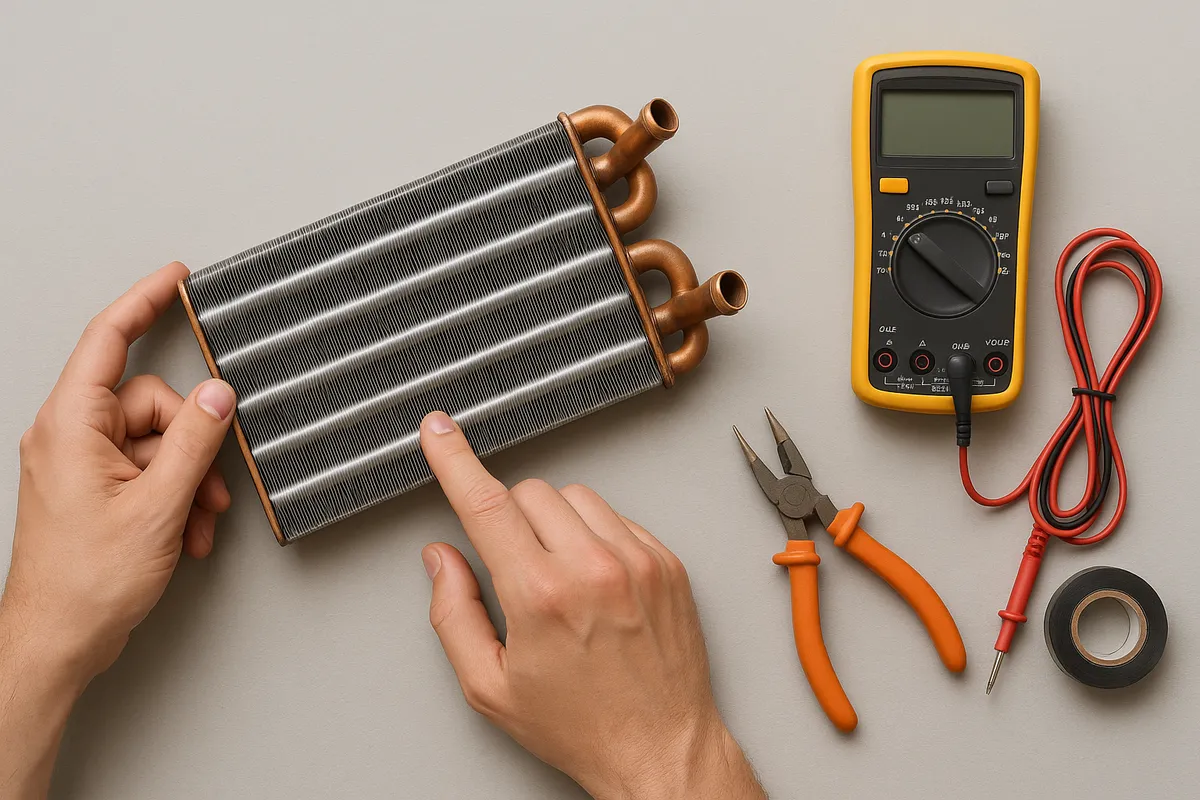
Tools used at this stage include a combustion analyzer, a digital manometer, and a clamp meter for measuring amp draw on the inducer motor and blower. These are not optional steps. They are how a technician distinguishes a $40 flame sensor fix from a $1,200 heat exchanger replacement.
Getting a Clear Estimate Before Any Work Starts
Once the root cause is identified, you should receive a written estimate that separates labor from parts. Be skeptical of any quote that bundles everything into a single number without explanation. A legitimate estimate will name the specific component, the part number if applicable, and the labor time expected.
Some repairs are straightforward. Replacing a draft inducer motor on a 90-plus furnace might take 45 minutes. Replacing a gas valve on an older unit can take two hours, especially if the valve is a legacy Honeywell model that requires careful gas line disconnection and leak testing afterward. The price difference between those two jobs is real, and you deserve to understand it before approving the work.
Protocol Services – Electric and Air advises clients to ask specifically whether the quoted repair addresses the root cause or just the symptom. A failed pressure switch, for example, is sometimes the actual fault. Other times it is tripping because the condensate drain is blocked or the inducer motor is weak. Replacing the switch without fixing the underlying condition means the system fails again within weeks.
The Repair Itself and What Good Workmanship Looks Like
Actual component replacement is often the shortest part of the process. What takes time is the work around it. Proper heating repair on a gas furnace includes shutting off the gas supply, verifying zero pressure with a manometer before opening any line, installing the new component, re-lighting and verifying ignition sequence, and then running a full combustion analysis to confirm CO output is within safe limits, generally under 100 parts per million air-free.
Electrical connections matter too. A wire nut that is finger-tight today will loosen under vibration within a season. Terminals should be crimped or torqued to spec. If a technician is done in under 20 minutes on a gas valve swap, that is worth questioning.
For residents in Rockaway Borough, NJ dealing with older homes where the heating system shares a mechanical room with the electrical panel, there can be code considerations around clearances and bonding. If those issues surface during a repair visit, a qualified technician will flag them rather than ignore them. You can learn more about combined HVAC service in Rockaway, NJ and what that coordination looks like in practice.
After the Repair: Testing, Documentation, and What to Watch For
A completed repair is not finished until the system runs through at least one full heating cycle under normal operating conditions. That means the thermostat calls for heat, the inducer starts, ignition occurs within the trial-for-ignition period (usually 90 seconds), the burners stay lit through the full cycle, and the blower comes on at the correct delay. Any deviation in that sequence points to a secondary issue.
You should receive documentation of what was replaced, the part number, and any readings taken before and after. Keep that paperwork. It becomes relevant if the system fails again and a warranty claim is involved. Most OEM parts carry a one-year warranty; labor warranties vary by contractor.
If the system fails again within 30 days of a repair, that is not normal. It suggests either a misdiagnosis or a secondary failure that was already in progress. For urgent situations, 24-hour emergency HVAC service in Rockaway and Morris County, NJ is available when a system goes down and waiting is not an option.
Protocol Services – Electric and Air operates out of 350 US-46 Ste 217, Rockaway, NJ 07866 and can be reached at (908) 878-6479. For homeowners in the area who want a straight answer about what is wrong with their system and what it will actually cost to fix it, they are a reliable starting point.
Frequently Asked Questions
What should I expect during the diagnostic visit?
A technician will gather information by checking error codes, measuring air temperatures, and verifying gas pressure. This step is crucial for accurately identifying the issue before any repairs are made.
How can I get a clear estimate for the repair work?
You should receive a written estimate that separates labor from parts and specifies the components involved. Be cautious of any quote that bundles costs together without detailed explanations, as understanding the root cause of the issue is essential before approving any work.
What happens after the repair is completed?
After the repair, the system must run through a full heating cycle to ensure everything functions correctly. You should receive documentation of what was replaced and any readings taken, which is important for potential warranty claims if the system fails again.
What common mistakes do homeowners make before calling for help?
Many homeowners try to replace parts themselves before calling, which can complicate the diagnostic process. For instance, installing a new igniter without addressing a cracked heat exchanger can lead to further issues, as the system may still leak combustion gases.
Get Directions to Protocol Services – Electric and Air
🎧 Listen to this as a podcast
Also on Apple Podcasts, Spotify, and Amazon Music.